Nissan Skyline R33 GT-R Common Problems: What to Check Before Importing from Japan
この記事の要点
- Read the listing fields first (they cost nothing), then ask your exporter for engine, drivetrain and underbody evidence, in that order.
- Of 41 BCNR33 listings seen on October 13, 2026, 14 show repair history, 10 have an odometer label that cannot be used as-is, and 6 show no repair history with both the maintenance-record and evaluation-sheet fields marked ○.
- Owner-log title counts (for example 26 titles with air-conditioning words, 3 with turbo words) are counts in a cut-off sample. They are not failure rates, and the sample cannot rank one term against another.
- Proceed, Conditional and Pass below are editorial judgments built from listing fields. They are not R33 GT-R pass rates.
Before importing a Nissan Skyline R33 GT-R (BCNR33), check the listing fields first, then ask your exporter for engine, drivetrain and underbody evidence in that order. The BCNR33 went on sale in January 1995; Nissan Heritage Collection lists the 1997 V-Spec with the RB26DETT, a 2,568 cc twin-turbo straight-six. Because you usually cannot touch the car, this guide turns what Japanese listings and Japanese owner logs show into a list of things to ask for.
The order is by seriousness and by how cheaply you can check. Listing fields are free to read and already rule out some cars. The engine is the most expensive thing to get wrong but needs your exporter to measure it. Drivetrain and steering come next, then the body. Counts below were taken on October 13, 2026.
Import eligibility is a separate question. For the United States, 49 CFR 591.5(i)(1) lists a vehicle that is 25 or more years old as one category of import declaration; EPA requirements are a different rule and are not covered here. Start with 25-year rule manufacture month for that.
Check the listing fields first, then ask your exporter for engine, drivetrain and underbody evidence, in that order
Five steps, in this order: identify the car, screen the listing fields, request engine evidence, request drivetrain evidence, request underbody photos.
- Identify: chassis code and grade field (V-Spec, four-door Autech, or neither).
- Screen the fields: repair history, odometer label, maintenance-record and evaluation-sheet fields.
- Engine and turbos: compression, borescope and power-balance readings.
- Drivetrain and steering: ATTESA E-TS, transfer, transmission, differentials, HICAS, clutch.
- Body: underbody and wheel-arch photos.
Two caveats shape everything that follows. First, the listing data are dealer-entered fields from one day. Second, the owner-log data are counts of words in titles, not records of failures. Section 6 and section 8 say how far each can be pushed.
Confirm the chassis code and grade, then screen the 41 listings’ fields: 14 show repair history, and 6 show no repair history with both the maintenance-record and evaluation-sheet fields marked ○
Read four things on your listing: the grade field, the repair-history field, the odometer label, and the maintenance-record and evaluation-sheet fields. Then find your row in the table below.
On October 13, 2026, a Goo-net search for “スカイラインgt-r bcnr33” returned 42 listings. One was an R32 (1990), leaving 41 R33 GT-R listings. One of those 41 has no model or grade field on its detail page, so its chassis code cannot be confirmed from the listing. Everything below counts these 41 listings, entered by dealers, on that one date.
Grade fields (41 listings):
| Grade field | Listings |
|---|---|
| V-Spec | 10 |
| Four-door “GT-R Autech Version 40th Anniversary” | 12 |
| Other GT-R (field says only “GT-R”, or no field) | 19 |
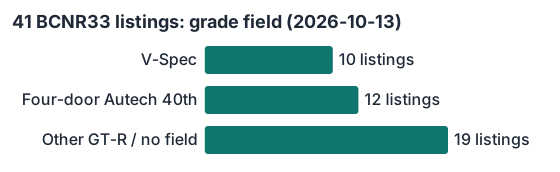
The chassis code alone does not tell you whether a car is a two-door or a four-door: 12 of the 41 are four-door Autech cars, so read the grade field. The 19 “other” listings cannot be called standard GT-Rs, because a dealer may simply have left “V-Spec” out. Nissan describes the V-Spec as a package first fitted to the R32 GT-R in February 1993, with Brembo brakes and 17-inch BBS wheels as standard. Nissan’s page does not say that ATTESA E-TS PRO is limited to the V-Spec, so do not assume it either way; ask. Initial registration years in these listings were 1995 (11), 1996 (14), 1997 (1) and 1998 (15).
Listing-field screen (41 listings, dealer-entered):
| Field | Reading | Listings |
|---|---|---|
| Repair history | あり (present) | 14 |
| Repair history | なし (none) | 27 |
| Odometer label | Shown as an unadjusted distance | 31 |
| Odometer label | 改ざん車 (tampered) | 4 |
| Odometer label | メータ交換 (meter replaced; the number shown is the post-replacement reading) | 5 |
| Odometer label | 走不明 (distance unknown) | 1 |
| Maintenance record (記録簿) | ○ | 15 |
| Maintenance record (記録簿) | − (not stated) | 26 |
| Evaluation sheet (車両状態評価書) | ○ | 13 |
| Evaluation sheet (車両状態評価書) | − (not stated) | 28 |
| No repair history, record ○ and evaluation sheet ○ | all three | 6 |
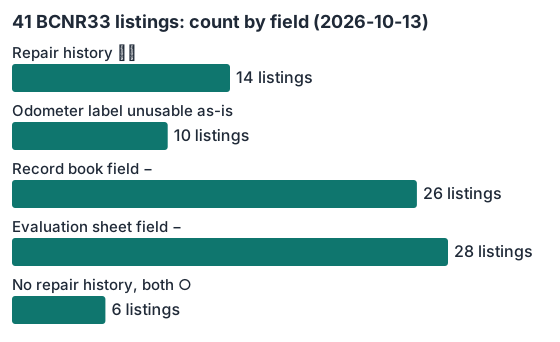
The “unadjusted distance” count of 31 is the 41 listings minus the 10 below (editor-calculated). The 10 whose odometer cannot be used on its own are the 4 tampered, 5 meter-replaced and 1 unknown; these labels do not overlap. Among the 31 with a plain number, 2 are under 3万km, 4 are 3万 to under 6万km, 9 are 6万 to under 10万km, 10 are 10万 to under 15万km and 6 are 15万km or more. Those bands are the editors’ own, and a displayed distance does not guarantee the actual distance driven.
Of the 14 listings with repair history, 3 are V-Spec, 3 are four-door Autech and 8 are other. The listing does not say what was repaired or how badly.
Read the ”−” fields carefully. It means “not stated”, not “does not exist”. And “none” in the repair-history field is the dealer’s entry; it is not the result of a third-party inspection. The 6 listings that satisfy all three conditions (2 four-door Autech, 1 V-Spec, 3 other) are not verified to have accurate documents; the fields only say something is claimed to exist. These 6 are the only ones I would send forward without first asking about a field.
Next steps for the documents themselves: auction sheet R vs RA for evaluation grades, Japanese vehicle documents for how to read the shaken certificate and chassis number, and maintenance record book for what a record book can and cannot prove. For mileage on the earlier model, see R32 GT-R high mileage.
Send to your exporter: “Please confirm the chassis code from the shaken certificate and tell me the grade (V-Spec, four-door Autech, or other). Please explain every repair-history, odometer and document field on this listing.”
Ask for the engine’s compression, borescope and power-balance readings, not a verbal “runs well”
The RB26DETT is the most expensive thing to misjudge, and the only way to see inside it remotely is to ask for measurements.
Nissan lists the 1997 V-Spec’s RB26DETT at 2,568 cc, 206 kW (280 PS) at 6,800 rpm and 368 N·m (37.5 kgf·m) at 4,400 rpm. Those are catalogue figures for that V-Spec; they say nothing about the engine in your listing.
NISMO’s Omori Factory, a specialist shop, shows what a specialist looks at. Its vehicle diagnosis for the Skyline GT-R (covering BNR32, BCNR33 and BNR34) includes, under work item 3, engine compression, a borescope check and a power-balance measurement. That is a reason to ask your exporter for the same three readings instead of accepting “engine is fine”.
The owner logs add a little context. Among the 1,039 titles (section 6), 3 contain turbine, boost-pressure or wastegate words, 9 contain cooling-system words (radiator, water temperature, overheating, water pump, electric fan, coolant, thermostat) and 3 contain oil-cooler, oil-leak, head-cover-gasket or oil-seep words. Those are counts of titles in a cut-off sample, not rates, and they do not tell you how long an RB26 lasts. I am not giving an engine life figure because no verified source provides one.
One owner’s self-reported log (July 25, 2021) shows why a measurement beats a guess: the car had uncontrollable boost pressure, and the shop’s finding was that the turbine was fine and a piping part had come off. That is a single, unverified owner account, but it shows that a “boost problem” is not automatically a “turbo problem”.
Send to your exporter: “Please return compression readings for each cylinder, borescope images, and a power-balance measurement. Please also report any oil leaks, any signs of overheating or coolant loss, and boost behaviour on a test drive if one is possible.”
Name the ATTESA E-TS, transfer, HICAS and clutch as separate line items in your request
Drivetrain and steering problems hide in separate parts, so list them separately instead of asking whether the “drivetrain is OK”.
NISMO’s diagnosis list for the Skyline GT-R includes, under chassis-side inspection, oil leaks from the ETS (E-TS), the transfer (T/F), the transmission (T/M) and the front and rear differentials, along with the HICAS rack boots and the HICAS ball joints. Nissan names the all-wheel-drive system as ATTESA E-TS PRO. As noted in section 2, do not read that as V-Spec only.
Owner-log title counts for these parts, again in a cut-off sample and not rates: 17 titles contain “clutch” (one of them is a scratch-shield accessory, so the count is of the word, not of clutch trouble), 5 contain power-steering words (power steering, PWST, rack boot, PS hose), 3 contain HICAS words and 3 contain ATTESA, E-TS or transfer words.
Two single-owner accounts show what these items can look like, and neither is a general finding:
- E-TS oil leak (December 19, 2020, 113,341 km). The owner wrote that oil was leaking from the hose running from the transfer to the E-TS actuator. The part was reported as discontinued, so the repair was a sealing repair; the labour charge was 3,300 yen. That is one shop’s labour, not a typical repair cost. The owner added a note years later that it had not leaked since.
- HICAS ball-joint replacement (December 30, 2025). An owner replaced the HICAS ball joints as a do-it-yourself job in under three hours, mentioning that parts were still available and that the work doubled as reconditioning.
I am not claiming HICAS or the E-TS is a known R33 weak point. The evidence here is the shop’s own inspection list and two individual stories. The request is what matters: ask for each of these as a separate line, so that a pass on one does not hide a gap on another.
I found no source for transmission synchro wear, so I give no figure; the request below only asks whether there are shifting problems.
Send to your exporter: “Please report oil leaks at the E-TS, transfer, transmission and front and rear differentials separately. Please check the HICAS rack boots and ball joints for play or damage. Please report clutch feel and any shifting difficulty, and whether the power steering has leaks or noise.”
Ask for underbody and wheel-arch photos: 25 of 1,039 log titles mention rust, rust-proofing or bodywork, and listing locations alone say nothing about rust
You cannot touch the car, so ask for photos of specific places and treat the absence of photos as an answer.
In the owner-log sample (section 6), 25 of the 1,039 titles contain the words for rust, rust-proofing or bodywork (錆, サビ, さび, 腐食, 防錆 or 板金). Those titles include rust-proofing jobs and panel work, so 25 is not the number of cars that rusted, and the sample is cut off per category, so it cannot say how often R33s rust.
What to request is the part you can control: photos of the underbody, the wheel arches, the boot floor, the jacking points and the area around the strut towers. I am not claiming these are the spots where R33s rust most often; I have no verified source that ranks them. They are where rust would be visible to a camera. For a practical method of reading rust photos from abroad, see how to check rust remotely, and for a sibling model’s inspection, see Skyline GT-R pre-purchase inspection.
A listing’s location is not a rust reading. The 41 dealers are in Kanto (15: Gunma 5, Saitama 4, Chiba 3, Kanagawa 2, Ibaraki 1), Kinki (8), Kyushu (8), Chugoku (4), Chubu (2), Tohoku (2), Hokkaido (1) and Shikoku (1). That is where the dealer is. The car may have been kept or used elsewhere, and the data show no link between location and rust.
Send to your exporter: “Please send photos of the underbody, all four wheel arches, the boot floor, the jacking points and the strut-tower area, taken in good light. Please say whether any rust-proofing or panel work has been done.”
Owner-log titles show what got serviced, not what fails, and the sample cannot rank terms, so use each count only to add a line item to your request
Each count below says how many of 1,039 titles contain a word. Use it to add a request line, not to decide which problem is bigger.
The sample is the Minkara maintenance-log (整備手帳) list for the “Skyline GT-R R33” group, taken on October 13, 2026. For each of 12 categories, I took the newest 100 entries (or all of them where there were fewer), giving 1,039 titles. The full lists hold 6,618 titles. Only titles were read, not the posts, and one title can match more than one word group. For the method, see how we aggregate Japanese owner logs.
Because every category was cut at 100, a word’s count depends on how big its category is. Engine logs are 100 of 1,800; electrical, 100 of 666; “other”, 100 of 193. A term that lives in a small category is shown more completely than one in a large category, so the table is ordered by the order of your checks, not by size, and I make no comparison between rows.
| Word group (titles containing it) | Titles | Add this to your request |
|---|---|---|
| Turbine, boost pressure, wastegate | 3 | Boost behaviour; piping and turbo condition |
| Cooling (radiator, water temperature, overheating, water pump, electric fan, coolant, thermostat) | 9 | Coolant loss, overheating signs, fan operation |
| Oil cooler, oil leak, head-cover gasket, oil seep | 3 | Engine oil leaks; underbody photos |
| “Clutch” in the title (includes one scratch-shield accessory) | 17 | Clutch feel, pedal, slave and master cylinders |
| ATTESA, E-TS, transfer | 3 | E-TS and transfer leaks |
| HICAS | 3 | Rack boots, ball joints, rod condition |
| Power steering (PWST, rack boot, PS hose) | 5 | Power-steering leaks and noise |
| Rust, rust-proofing, bodywork | 25 | Underbody and arch photos |
| Air conditioning (A/C, condenser, heater pipe, evaporator) | 26 | Whether the A/C blows cold; refrigerant history |
| Of those A/C titles: gas, refrigerant, leak-stop, leak | 9 | Whether refrigerant has been topped up, and when |
The air-conditioning count is the 34 titles with air-conditioning words minus 8 about relocation, panels, filters, vents, a shop name, LED or “について” posts. It includes repair, top-up, replacement and cleaning. I do not explain why A/C appears as it does, because the titles do not say whether anything actually failed or how old the cars were.
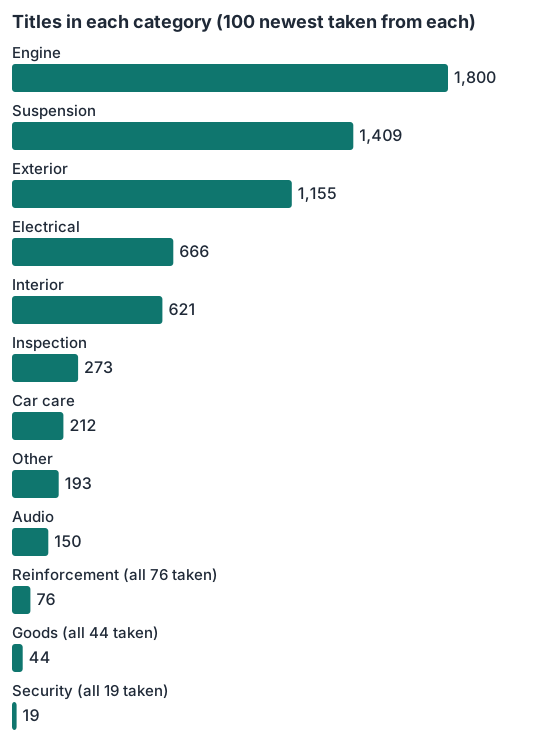
Titles taken from each category’s full list:
| Category | Taken / total titles |
|---|---|
| Engine | 100 / 1,800 |
| Suspension | 100 / 1,409 |
| Exterior | 100 / 1,155 |
| Electrical | 100 / 666 |
| Interior | 100 / 621 |
| Inspection | 100 / 273 |
| Car care | 100 / 212 |
| Other | 100 / 193 |
| Audio | 100 / 150 |
| Security, body reinforcement, goods | 19 / 19, 76 / 76, 44 / 44 |
A small fraction taken (engine, suspension, exterior) means a term in those categories is less likely to appear in the sample, so a low count does not mean “rarely serviced”. For the same reason, I do not use the counts to say which item is bigger or smaller. For a sibling model’s treatment of the same kind of data, see common problems before importing (Forester SG5 STI).
Combine what the listing shows into Proceed, Conditional or Pass, then send one message to your exporter
Find every row that matches your listing, add up the requests, and take the strictest verdict among the rows that match.
How to use: collect all rows that apply to your listing and add every “What to ask for” to your message. The verdict is the strictest of the matching rows (Pass beats Conditional beats Proceed). Proceed applies only if no other row does.
| What the listing shows | Verdict (editorial) | What to ask for |
|---|---|---|
| Odometer label 改ざん車 (4 of 41) | Pass | The distance cannot be used. Look for another car; unless records prove the real distance, there is no reason to continue. |
| Model/grade field empty (1 of 41) | Conditional (identify first) | Shaken certificate / chassis number to confirm the chassis code. Do not move to other requests until confirmed. |
| Odometer label 走不明 (1) | Conditional (only if the record book traces the history) | A copy of the record book. If none is produced, Pass. |
| Odometer label メータ交換 (5) | Conditional (only if the pre-replacement distance is documented) | Documents showing the pre-replacement distance. If none, Pass. |
| Repair history あり (14: V-Spec 3, four-door Autech 3, other 8) | Conditional | The repair location, extent, repair invoice and photos (the listing does not show cause or extent). If no explanation, Pass. |
| Only the record-book field is ”−” (evaluation sheet ○; repair history irrelevant) | Conditional | Whether a record book exists. ”−” does not mean it does not exist. If none is produced, treat maintenance history as unknown. |
| Only the evaluation-sheet field is ”−” (record book ○) | Conditional | Whether a vehicle condition evaluation sheet exists. If none, treat third-party evaluation as absent. |
| Both record-book and evaluation-sheet fields ”−” | Conditional (both requests above) | Whether each exists. If neither is produced, you will be relying only on the results of sections 3 to 5. |
| No repair history, record book ○ and evaluation sheet ○ (6 of 41), and no row above applies | Proceed (to the inspection request) | Copies of the documents plus the full request set from sections 3 to 5. The documents are not verified to exist or to be accurate. |
Proceed, Conditional and Pass are editorial judgments, not an R33 GT-R failure rate or pass rate. The boundaries come from listing-field categories (dealer-entered); no kilometre or score threshold is used. “Proceed” means “go on to the inspection request”, not “buy”.
Example: a car with repair history あり and an odometer label メータ交換 matches two Conditional rows. Send both requests (the repair invoice, and the pre-replacement distance). If a 改ざん車 label were added, the verdict becomes Pass.
Even a “Proceed” car gets the full request in sections 3 to 5. Whether it is a four-door Autech or a two-door is checked separately in the grade field (section 2).
Send the checklist as one message. This template folds in each line item from sections 2 to 6:
Before I decide on this car, please return the following. (1) The chassis code from the shaken certificate, and the grade. (2) An explanation of the repair-history, odometer-label, record-book and evaluation-sheet fields; if repair history is あり, the repair location, extent, invoice and photos; if the odometer label is メータ交換 or 走不明, documents for the earlier or actual distance. (3) Engine: compression readings, borescope images and a power-balance measurement; any oil leaks, overheating or coolant loss; and boost behaviour if it can be driven. (4) Drivetrain: oil leaks at the E-TS, transfer, transmission and front and rear differentials, listed separately; HICAS rack boots and ball joints; clutch feel and any shifting problems; power-steering leaks or noise. (5) Air conditioning: whether it blows cold, and any refrigerant history. (6) Photos of the underbody, wheel arches, boot floor, jacking points and strut-tower area, and whether rust-proofing or panel work was done. Please tell me which items you cannot confirm before the bid.
As a reference for the cost of a specialist look: the NISMO Omori Factory page I read on October 13, 2026 lists its Skyline GT-R vehicle diagnosis (BNR32, BCNR33, BNR34) from 317,000 yen including tax, with oils and labour included and additional work extra. That is one shop’s service price, not a market rate for pre-purchase inspections, and whether to book it is your decision. Once the car passes, compare the money side with Japanese auction prices.
These counts are snapshots of owner titles and dealer-entered listings, so read them as prompts for questions, not as rates
Both data sets are small, cut off or dated, and made for asking questions of your exporter.
Owner-log titles (Minkara). Taken October 13, 2026 from the newest 100 entries in each of 12 categories (1,039 titles of 6,618). The fraction taken ranges from 100 of 1,800 to all of a category’s titles, so counts for different words cannot be ranked against each other. Only titles were read; owners are Japanese enthusiasts; heavy work sent to shops may not appear as a title. The “clutch” count of 17 is a count of the word and includes one scratch-shield accessory. The three individual accounts are single, self-reported cases.
Listings (Goo-net). A one-day snapshot (October 13, 2026) of 41 R33 GT-R listings from a free-word search, entered by dealers. N = 41 does not generalise to the Japanese market, and I did not split by region or model year. Dealer locations are not storage locations.
Update triggers: when a new listing count moves the repair-history, three-field or odometer-label numbers a lot, or when NISMO changes the diagnosis items or price. For how this kind of count is built and why it is not a rate, see method: Minkara aggregation.
FAQ
Q1. Is every BCNR33 a two-door coupe?
No. Among the 41 listings seen on October 13, 2026, 12 were four-door “GT-R Autech Version 40th Anniversary” cars. The chassis code alone does not show this, so read the grade field.
Q2. Does a “V-Spec” listing mean the ATTESA E-TS PRO is different?
Nissan describes the V-Spec as a package (Brembo brakes, 17-inch BBS wheels) first fitted to the R32 GT-R in February 1993. Nissan’s V-Spec page names ATTESA E-TS PRO but does not say it is limited to the V-Spec, so ask your exporter what the individual car has.
Q3. Is a listing with “repair history: none” safe?
Not by itself. In the 41 listings, 27 say none, but that is the dealer’s entry, not a third-party inspection result. Ask for the record book and evaluation sheet as well; only 6 listings had no repair history and both fields marked ○.
Q4. How much does a specialist inspection cost in Japan?
NISMO Omori Factory lists its Skyline GT-R vehicle diagnosis (BNR32, BCNR33, BNR34) from 317,000 yen including tax, with oils and labour included and additional work extra, as read on October 13, 2026. That is one shop’s price, not a market rate; your exporter’s inspection may include different items.
Q5. Are air conditioning problems the most common R33 GT-R fault?
This data cannot say. 26 of 1,039 owner-log titles contain air-conditioning words, but that counts words in titles, not failures, and the sample was cut at 100 per category (100 of 1,800 in the engine category, all 19 in security), so no term can be called the most common.