Toyota Altezza SXE10 Beams 3S-GE Problems: What to Check Before Importing from Japan
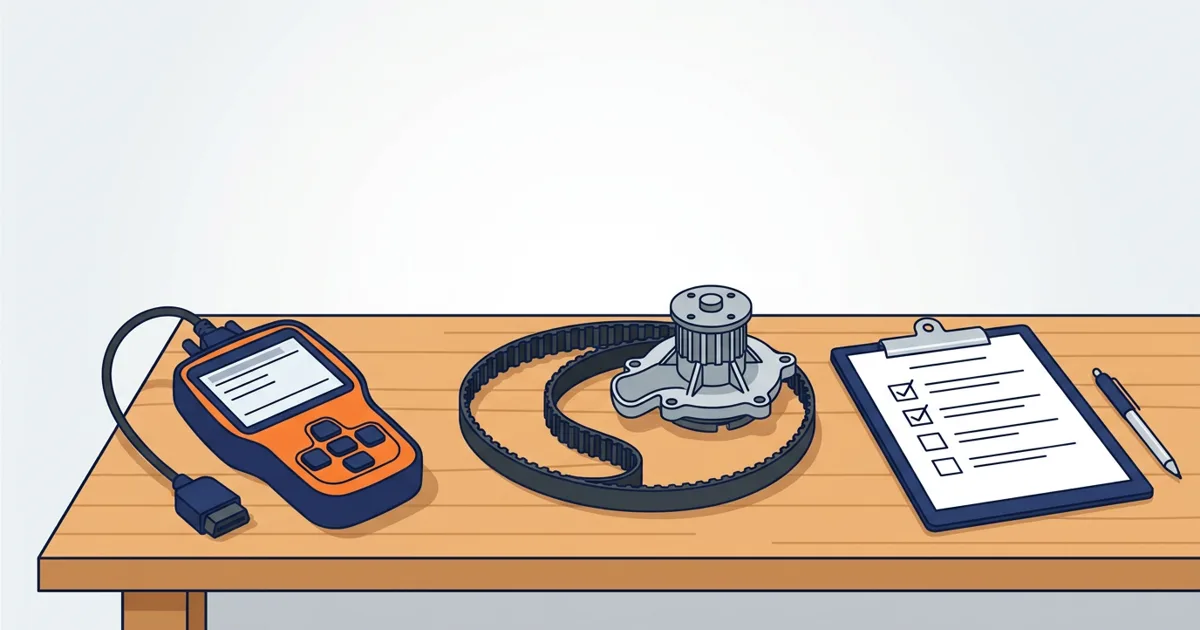
Before importing a Toyota Altezza SXE10 Beams 3S-GE (RS200), check the chassis code and chassis number in the listing first, then ask your exporter for belt records, scan-tool data and trunk photos, in that order.
この記事の要点
- Order of checks, from free to effortful: (1) the listing’s chassis code, engine and transmission; (2) the chassis number against Toyota’s 2011 free-inspection campaign range; (3) timing-belt and water-pump records; (4) scan-tool readout and a cold-start video; (5) automatic cars only: ATF history and a manual-mode shift video; (6) trunk and rear-window photos.
- The order follows seriousness and how easily each item can be checked from abroad. It is not a ranking of how often each fault occurs.
- Costs below come from single owner posts on Minkara (a Japanese owner-log site) and are not market prices or repair-shop quotes. Data as of October 23, 2026.
- Whether the US 25-year rule applies to your car is a separate question, covered in 25 year rule manufacture month.
Check the chassis code and chassis number first, then ask your exporter for belt records, scan-tool data and trunk photos, in that order
You cannot inspect the car yourself, so every item below is phrased as something you ask the exporter to send: a copy of a record, a scan-tool screen, a video or a photo.
The first two steps cost nothing, because they only need the listing and the registration papers. The later steps ask the seller for more work, so they come after you know the car is the right type and which campaign range it sits in. The Altezza was launched in Japan on October 30, 1998 (Toyota 75-year history, retrieved October 23, 2026).
This article does not publish failure rates. The evidence is a set of individual owner posts and one official Toyota campaign notice. Read each section as “what to ask”, not “how likely”.
Make sure the listing says SXE10 with the 3S-GE, and note whether it is the 6-speed manual (210 PS) or the 5-speed automatic (200 PS)
The chassis code, engine and transmission fields decide which parts of this article apply to your car.
| Listing says | Engine | Output (published figure) | Transmission |
|---|---|---|---|
| SXE10, RS200, manual | 3S-GE, 1,998 cm3, 4-cylinder | 210 PS at 7,600 rpm | 6-speed manual |
| SXE10, RS200, automatic | 3S-GE, 1,998 cm3, 4-cylinder | 200 PS at 7,000 rpm | 5-speed automatic with steering-wheel shift switches (Steermatic) |
| 6-cylinder variant | 1G-FE | 160 PS at 6,200 rpm | not covered here |
Source: Toyota 75-year history vehicle lineage table and Toyota Certified Used Car catalogue for the RS200 (October 1998 to May 2000), retrieved October 23, 2026. The difference between the manual and automatic 3S-GE is 10 PS (editorial calculation: 210 minus 200).
Toyota’s history page also uses “200PS” in running text, but its specification table gives 210 PS for the manual and 200 PS for the automatic. This article uses the table.
If the engine or code field is empty, or shows the 6-cylinder 1G-FE, stop here and have the exporter confirm the code and engine from the registration papers. The belt and VVT items below are for the 3S-GE. To read the papers themselves, see Japanese vehicle documents. For reading the grade on an auction sheet, see auction sheet R vs RA.
Send the exporter: “Please confirm from the registration papers the chassis code, the engine type and the transmission (MT or AT).”
Compare the chassis number with Toyota’s 2011 free-inspection campaign range (SXE10-0001001 to SXE10-0041470), and ask whether the inspection was done
Toyota ran a free-inspection service campaign for 11 models starting on November 24, 2011 (Heisei 23), and the SXE10 Altezza is inside it.
What the campaign covers
- Problem: the sliding part of the lower ball joint can wear beyond its limit after long use with insufficient maintenance, which can cause noise and heavier steering, and the joint can come apart if left.
- Range for the GF-SXE10: chassis numbers SXE10-0001001 to SXE10-0041470, built from October 12, 1998 to December 27, 2000. The GXE10 is also covered, under a separate range.
- The inspection is free, with an inspection-result label attached. If a fault is found, the repair is paid.
- Toyota notes that the range includes vehicles that are not subject to the campaign.
To use this: compare the chassis number on the listing or registration papers with the range. A number inside the range does not mean the car was inspected, and it does not mean the car is affected, because the range includes vehicles that are not targets. The proof that the inspection was done is a record or the label, so ask for one of those. The campaign is a free inspection, not a recall, and a record of it does not guarantee the joints are in good condition today.
If the listing shows no chassis number, treat the car as possibly in range and ask.
Send the exporter: “The chassis number is SXE10-[number]. Please send any record or label showing the 2011 Toyota lower ball joint inspection, and photos of the front lower ball joint boots.”
The 3S-GE in the SXE10 is belt-driven, so ask for the last timing-belt record and whether the water pump was done with it
One owner post shows the belt being replaced on an SXE10, so ask for the last replacement date, the mileage at that time and whether the water pump was done at the same time.
This article does not give a replacement interval, because we have no Toyota-published figure for it. The question to ask is therefore about the record, not about a number.
What owner logs show:
- A timing-belt replacement posted on November 10, 2013 for an SXE10 also covered the oil seal of the “VVTI sprocket”, the water pump, the thermostat and hoses (Minkara owner log).
- In the same post, the water pump could not be removed without taking off the air-conditioning compressor bracket. That is one reason a mechanic may do the pump while the belt is already off, because the labor is shared.
- A separate post (September 11, 2020) traced a coolant leak to the radiator end of the upper hose. The owner had fitted a silicone aftermarket hose, and the leak stopped after returning to the genuine radiator hose. This is one case, not a typical cause.
Whether a maintenance record book can prove this work is covered in maintenance record book.
Send the exporter: “Please send a copy of the record showing the last timing-belt replacement (date and mileage), whether the water pump was replaced at the same time, and photos of the hose joints and the radiator area for coolant traces.”
For engine-lamp, idle and rpm symptoms, ask for scan-tool readouts and a cold-start video, not a verbal “runs fine”
Owner posts show the engine-lamp, VVT and electronic-throttle faults being found by a scan tool, so the useful request is a readout and a video, not a statement.
VVT system. A post dated March 22, 2015 describes an engine check lamp on with idle at 2,000 rpm. The owner’s diagnosis was that the exhaust-side valve plunger was stuck on the high side, while the intake side moved smoothly. The owner noted that the dealer’s estimate to repair the VVT system was about 250,000 yen (described as a generous estimate, not an actual bill). The owner ordered the camshaft timing oil control valve for 14,796 yen (part numbers 15330-74040/74041).
Do not compare these two figures directly. Dividing the estimate by the part price gives 16.9 (editorial calculation: 250,000 divided by 14,796). That figure is not a mark-up: the estimate covers a whole repair and the part price is one valve on one side. Use it only to see that a part price alone does not describe the repair.
Electronic throttle. Two posts show different symptoms:
- Code P1128 (throttle motor lock) was recorded on a car at about one hundred thousand km that stalled at steady speed (post dated May 19, 2014). The owner’s own conclusion was dirt around the throttle butterfly plus the adjustment screw.
- A post dated February 12, 2023 from an owner in Australia describes revs staying at 3,000 rpm on the highway. The diagnostic result listed the throttle motor, the intake-air temperature sensor and the VVT solenoid valve. The owner’s parts cost was about 70,000 yen, shipped from Japan during a weak yen, for the throttle motor, intake-air temperature sensor, VVT solenoid, gasket and radiator hose together.
Titles in the engine-section list. On October 23, 2026 (retrieval date), the third page of Minkara’s engine-section list for the Altezza RS included titles such as “VVT-i pulley replacement”, “timing belt replacement, second time”, “fuel pump replacement” and “solenoid installation”. On the first page there were two titles about fuel-pressure pulsation-damper replacement. These are titles on the retrieval date, listed to show what owners have logged. The list changes daily, so they say nothing about frequency. See method (Minkara aggregation) for how to read owner posts.
For a similar Toyota of the same period, see MR2 SW20 common problems before importing.
Send the exporter: “Please send photos of the scan-tool screen showing stored codes and freeze-frame data, and a video of a cold start and idle with the engine lamp visible. Please also tell me if the lamp has been on at any time.”
On automatic cars, ask for ATF service history and a manual-mode shift video; one owner’s solenoid job and an ATF change are examples, not norms
This section applies only to the 200 PS automatic (the manual-car reader can skip to the next section).
Automatic cars only. The owner posts describe the automatic gearbox as the A650E (the owner’s wording). Manual cars skip this section.
- ATF change: a post dated November 4, 2013 reports a 7.2 L specified capacity, about 13 L used with a pressure-exchange method, 15,757 km since the previous change (the car was at 44,659 km). The owner used genuine Toyota ATF T-IV and reported that occasional shock on 2-3 and 3-2 shifts was gone.
- Shift solenoids: a blog post dated July 19, 2017 says that replacing two shift solenoids at a dealer cost a little under 80,000 yen, labor included, “as I recall”. The symptom was that the car drove normally in D but could not be shifted manually in M mode.
These are one-owner records, and the second is from memory. They do not show how the automatic compares with the manual in reliability. We have no source for that. They show what to ask: the ATF change history, and a video of shifting in D and in M mode.
Send the exporter: “For this automatic car, please send the ATF change history (date and mileage), and a video of driving in D and of manual-mode up and down shifts.”
Ask for trunk-floor and rear-window photos, because trunk leaks in owner logs had more than one cause
Three owner posts about trunk leaks name three different entry points, so a single photo of the trunk lid is not enough.
One repair bill is not a price list. The causes differ and so do the bills. Do not use one figure to judge the cost of a leak.
- Rust inside the roof molding lifted a body seam, letting water in (post dated October 18, 2023, explanation from a body shop). The cause was not in one place only.
- Water entering near the right edge of the rear window: in a post dated April 17, 2018, the body shop’s bill was, in the owner’s wording, 5,400 yen. The owner had braced for thirty to forty thousand yen. This is a reading of the owner’s spoken-out price, not a printed amount.
- A leak 18 years after first registration (post dated July 3, 2017): the owner suspected a cracked panel bond and degraded weatherstrip adhesive and resealed with sealant.
Ask for photos of the trunk floor, the spare-wheel well, the rear window and roof-molding edges, and any visible sealant repairs. For how to check rust from photos, see how to check rust remotely.
Send the exporter: “Please send photos of the trunk floor with the mat lifted, the spare-wheel well, the corners around the rear window and the roof molding, and say whether any sealing or panel repair has been done.”
Combine what the listing and records show into Proceed, Conditional or Pass, then send one message to your exporter
Match your listing to every row that applies, add all of the requests in those rows, and take the strictest verdict among them (Pass is stricter than Conditional, which is stricter than Proceed). Proceed applies only when no other row does.
| What the listing shows | Verdict (editorial) | What to ask the exporter |
|---|---|---|
| Chassis code or engine is not SXE10 / 3S-GE, or the field is empty | Conditional (identify first) | Confirm code and engine from the registration papers. Do not go further until confirmed. If it is the 6-cylinder 1G-FE, the 3S-GE belt and VVT items here do not apply. |
| Chassis number is within SXE10-0001001 to SXE10-0041470, or no chassis number is shown | Conditional | Record or label of the 2011 free inspection. The range includes vehicles that are not targets. Even if inspected, the record does not guarantee the present state of the suspension. |
| No timing-belt replacement record, or no date and mileage | Conditional (only if the record appears) | Date and mileage of the last belt replacement, and whether the water pump was done (copy of the record). If none appears, treat as not replaced and raise the priority of these requests. |
| Listing or dealer notes mention an engine lamp, unstable idle or revs that do not return | Pass (until a scan-tool readout appears) | Photos of the codes and freeze-frame data, and a cold-start and idle video. If the code (for example P1128) is explained and the cause and repair details are provided, move back to Conditional. If refused or ignored, pass on the car. |
| No warning lamp or symptom noted | Conditional | Scan-tool readout of stored codes and a cold-start and idle video. No note does not mean no problem. |
| Transmission field says AT | Conditional (add the AT items) | ATF change history and a video of D driving and M-mode shifts. If M mode is noted as not working, prefer another car. |
| Water staining, rust or trunk stains in the listing or photos, or no photos provided | Conditional | Photos of the trunk floor, spare-wheel well, rear window and roof molding. If no cause and repair details are given, Pass. |
| Service record book field shows ”-” or no records are offered | Conditional | Ask whether a record book exists. If not, treat the history as unknown and send all of the above requests. |
| None of the above applies (SXE10 and 3S-GE, chassis number outside the range, belt record shown, no notes, manual, photos supplied, record book present) | Proceed (go to inspection requests) | Copies of the documents, plus the full set of requests in the sections above. The documents have not been verified as genuine or accurate. |
Proceed, Conditional and Pass are the editors’ judgments, not Altezza failure rates or pass rates. The boundaries come from the listing fields and from whether records exist, and we did not use mileage or score thresholds. “Proceed” means “go on to the inspection requests”, not “buy it”. Even at Proceed, do not skip the requests in the sections above.
For example, an automatic car with a chassis number in range and no belt record gets three Conditional rows, and you add all three sets of requests (AT records, campaign record, belt record). All three are Conditional. If the listing also says “engine lamp on”, the verdict becomes Pass until a scan-tool readout appears.
Pass here does not mean the repair is expensive or common. It means a symptom is declared and no information explains its cause.
Send one message with the relevant items from this list, in order:
- "Please confirm the chassis code, engine and transmission from the registration papers, and send the chassis number."
- "Please send any record or label of Toyota's 2011 lower ball joint free inspection."
- "Please send the last timing-belt record (date, mileage, water pump)."
- "Please send scan-tool screen photos (stored codes, freeze frame) and a cold-start and idle video."
- (Automatic only) "Please send the ATF change history and a video of D driving and M-mode shifts."
- "Please send trunk-floor, spare-well, rear-window and roof-molding photos."
Individual repair amounts from owner posts (not market prices). Each is a single post, with the conditions shown:
| Item | Amount | Conditions |
|---|---|---|
| VVT system repair | about 250,000 yen | Dealer estimate, described as generous, posted March 22, 2015; not an actual bill |
| Camshaft timing oil control valve | 14,796 yen | Part price only, one valve, ordered by the owner |
| Throttle motor and related parts | about 70,000 yen | Parts only, shipped from Japan, weak-yen period; includes intake-air temperature sensor, VVT solenoid, gasket and radiator hose |
| Automatic shift solenoids (two) | a little under 80,000 yen | Dealer, labor included, owner’s recollection, blog dated July 19, 2017 |
| Trunk leak repair | 5,400 yen | Owner’s wording, body-shop bill, posted April 17, 2018 |
For checking prices of cars themselves, see Japanese auction prices.
These are individual owner posts and one dated snapshot, not failure rates, so read them as prompts for questions
The evidence here is a set of single owner posts, not a count of faults.
Minkara’s owner-log section for the Altezza 10 series showed 27,772 entries on October 23, 2026. We did not count those entries. This article reads individual posts (the ones cited above) and does not report how many posts describe each fault.
- Each case is one car and one owner (N=1), so no case shows how common a fault is.
- The posters are enthusiasts in Japan and Australia. Heavy repairs sent to a shop may not appear in the logs.
- The title lists are as of the retrieval date and change daily.
- An estimate and a bill are different things, and the 5,400 yen figure is a reading of the owner’s wording.
- We did not cover Dual VVT-i, changes between model generations or other Altezza variants such as the 6-cylinder cars, because we could not confirm them from first-hand sources.
For the method used to read owner logs, see method (Minkara aggregation). For another Toyota of the same type of check, see Alphard ANH20 common problems before importing.
よくある質問
Q1. Is the SXE10 Altezza timing-belt or chain-driven?
One SXE10 owner post (November 10, 2013) shows a timing-belt replacement together with the water pump, so for the SXE10 3S-GE, ask for the belt record. We do not state anything about other generations of the engine here.
Q2. Does my SXE10’s chassis number fall in the 2011 Toyota campaign range?
The free-inspection campaign (start date November 24, 2011) covers GF-SXE10 chassis numbers SXE10-0001001 to SXE10-0041470. The range includes vehicles that are not targets, so being in range does not mean the car is affected. Whether the inspection was done is shown by a record or the label, so ask the exporter for it.
Q3. How much does a VVT-i repair cost on an Altezza?
We cannot give a price. One owner post cites a generous dealer estimate of about 250,000 yen (March 22, 2015) and a part price of 14,796 yen for one oil control valve. These are not comparable and not a market price. Ask for a scan-tool readout and a repair quote for your car instead.
Q4. Is the automatic Altezza much weaker than the manual?
The published output difference is 10 PS (3S-GE, 210 PS manual and 200 PS automatic). We have no source on relative reliability, so we do not rank them. Automatic cars simply get extra requests: the ATF history and a manual-mode shift video.
For the turbocharged 3S-GTE sibling and its extra intercooler-circuit checks, see Toyota Celica GT-Four ST205 (3S-GTE).