R32 GT-R High Mileage: Where 10万km Sits in 48 Japan Listings
この記事の要点
- Among 48 Japanese BNR32 GT-R listings with a normal odometer reading (Goo-net, retrieved October 13, 2026), the median is 6.85万km (万 = 10,000, so 6.85万km is about sixty-eight and a half thousand km) and 16 of 48 (33%) show 10万km or more. A six-figure reading is common, so the number alone does not decide the bid.
- Check the odometer column first. 16 of the 64 listings show “meter replaced”, “tampered vehicle” or “distance unknown” instead of a number; those cars cannot be placed in a km band.
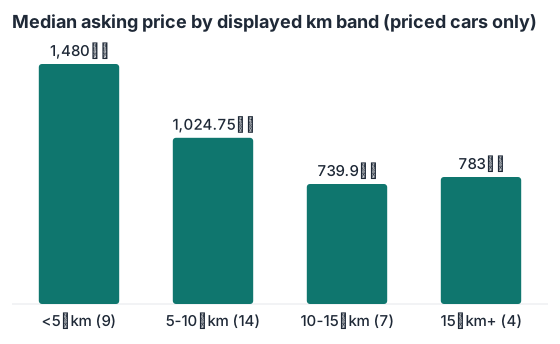
- Lower-km listings ask more (median 1,480万円 under 5万km, 9 priced cars; 万円 = 10,000 yen), but the 15万km-plus end rests on only 4 priced cars.
- No source here gives an RB26DETT life in km. The decision table below is an editorial judgment built on the odometer status, a 10万km line taken from Nissan’s general belt rule, and whether service records exist.
For the Nissan Skyline R32 GT-R with high mileage, the useful question is not “what number kills an RB26” but “what does this reading tell me, and what must the exporter show before I bid.” This guide uses a one-day sample of Japanese retail listings, Nissan’s and NISMO’s own published rules, and two owner self-reports. It does not estimate engine life.
A six-figure odometer reading is common on a BNR32 GT-R: 16 of 48 Japanese listings show 100,000 km or more
Among 48 listings with a normal odometer reading (Goo-net, retrieved October 13, 2026), the median is 6.85万km; 16 show 10万km or more, 6 show 15万km or more and 2 show 20万km or more.
The sample is Goo-net’s used-car results for the search “bnr32 スカイラインgt-r”, pages 1 to 3, 64 cars in total. Goo-net lists retail asking data, not completed sales and not a guarantee of true distance. 48 of the 64 cars show an ordinary number in the odometer column, and all distribution figures below use only those 48. The two cars at 200,000 km or more are both 1989 models (20.8万km and 24.8万km).
| Displayed mileage (48 listings, normal odometer) | Cars |
|---|---|
| Under 5万km | 16 |
| 5万km to under 10万km | 16 |
| 10万km to under 15万km | 10 |
| 15万km and above | 6 |
Only the BNR32 is the GT-R of the R32 generation; Nissan’s heritage page for the 1989 GT-R carries the BNR32 designation. The other R32 Skylines are different cars, so read the chassis-code field on the listing before reading the kilometres.
If you plan to import to the United States, the 25-year question is separate from mileage: the federal rule (49 CFR 591.5(i)) requires a vehicle that is 25 or more years old, and the month-level detail is in 25-year rule manufacture month.
Check the odometer status first: 16 of the 64 listings have no usable reading
Before any km band, read what the odometer column says. 48 listings show a number; 6 say meter replaced, 5 say tampered vehicle and 5 say distance unknown.
| Odometer column on the listing | Cars (of 64) |
|---|---|
| Normal number | 48 |
| Meter replaced (メータ交換) | 6 |
| Tampered vehicle (改ざん車) | 5 |
| Distance unknown (走不明) | 5 |
These 16 cars are left out of every distribution below. For them, the km figure is not the question; the proof of what the car has actually done is. Three English-language buyer’s guides also warn that the odometer can be hard to verify on this model; this article does not rely on their claims, only on the Goo-net classification above. The way an exporter should present the sheet is covered in auction sheet R vs RA.
If your listing shows meter replaced, tampered vehicle or distance unknown, stop comparing it with the km bands. The next step is a record that shows the distance before the change, not a price comparison.
Lower-km listings ask more: median 1,480万円 under 5万km vs 778万円 at 10万km or more (9 and 11 priced cars, Goo-net 2026-10-13)
Asking prices are higher in the lower-km bands, with 9, 14, 7 and 4 priced cars per band. It is an observation of one day’s retail listings, not proof that kilometres set the price.
The prices below are the car body price shown on the listing. Cars shown as “ASK” (price on request) are excluded from the price columns, which is why priced cars are fewer than listed cars. All counts use the 48 normal-odometer cars.
| Displayed mileage | Cars | Priced cars | Median asking price | Range | Repair history “yes” |
|---|---|---|---|---|---|
| Under 5万km | 16 | 9 | 1,480万円 | 860 to 1,900万円 | 1 of 16 |
| 5万 to under 10万km | 16 | 14 | 1,024.75万円 | 739 to 1,650万円 | 7 of 16 |
| 10万 to under 15万km | 10 | 7 | 739.9万円 | 559.9 to 987.6万円 | 2 of 10 |
| 15万km and above | 6 | 4 | 783万円 | 738 to 798万円 | 3 of 6 |
Three cautions apply to this table.
- It does not separate model years or grades (V-Spec and others), so a band’s median partly reflects which cars happen to be listed.
- The 15万km-and-above row rests on 4 priced cars. It is too thin to tell you whether a given asking price is fair. The 10万 to 15万km (739.9万円) and 15万km-plus (783万円) medians are not even in the order you might expect.
- These are retail asking prices on one site on one day. They are not auction results and not completed sales.
Repair history does not rise with kilometres in this sample (1, 7, 2 and 3 cars across the four bands, from the lowest to the highest), so no one-way trend should be read into it. For the price you may actually pay at auction, see researching Japanese auction prices; for how buyers read prices by destination, see Japan export price.
Divide the reading by the car’s age: under 1,000 km a year is a reason to verify, not a bargain
Editorial calculation: km divided by (2026 minus model year). The median across the 48 normal-odometer cars is 2,071 km a year, and 9 of 48 are under 1,000 km a year.
Use the formula on your own listing’s displayed distance and model year. The model year is a simple subtraction; the registration month is not taken into account, so treat the result as approximate. If the model year is unclear, Japanese vehicle documents explains where to find it.
| Km per year (editorial calculation, 48 cars) | Cars |
|---|---|
| Under 1,000 | 9 |
| Under 3,000 | 32 |
| 5,000 or more | 3 |
The range across the 48 cars runs from 65 to 6,703 km a year. A very low figure is not a sign of a good car; it is a figure the records should be able to explain (storage, collection, long periods off the road). Treat anything under 1,000 km a year as a car to verify, and do not use it to justify a higher bid.
The two 1989 cars at 200,000 km or more are a different reading of the same arithmetic. One such listing shows 24.8万km, a 788万円 price and a repair history mark; it is a single listing and shows what is for sale, not how long an engine lasts.
Mileage does not set an engine’s life: what Nissan’s own rules, NISMO’s rebuild process and real high-mileage owners show
Nissan’s published rule is general, NISMO’s published process is a full rebuild, and the two owner reports are existence checks. None of them gives an RB26DETT life in km.
Nissan’s rule is general, not RB26-specific. Nissan’s FAQ says a timing belt is a periodic-replacement part every 10万km, with some engines excepted and the maintenance note governing, and recommends replacing it at the inspection before 10万km. For a timing chain or gear it says they are not periodic-replacement parts. Whether the RB26DETT uses a belt or a chain is not confirmed in the sources used here, and no RB26-specific replacement distance was found. English guides repeat that the belt records matter on this engine; this article does not repeat their numbers. The practical request is “records of the cam-drive system replacement”, whatever the engine uses.
What the listings show. 7 of the 64 listings mention a timing belt replacement in the listing title; a missing mention does not mean it was not done. Two examples: a 1992 car shown at 13.9万km was serviced at 138,597 km (dealer-stated), and a 1993 car shown at 5.4万km at 53,613 km. In both the service was done almost at the displayed distance, so the number tells you when, not what is inside.
NISMO treats restoration as a rebuild. NISMO’s restored-car service (announced December 4, 2020 for the R32, R33 and R34 GT-R) includes a full-disassembly overhaul, balancing and bench power measurement of the engine, plus body torsional stiffness and dimension measurement; production takes about six months to one year. NISMO Heritage Parts are not available for overseas use: NISMO states that for use abroad they are all outside the programme’s coverage, and delivery can take several months or more. For an overseas buyer this means that official remanufacturing support is not a safety net.
Two owner self-reports (existence, not statistics). One Minkara owner bought an E-BNR32 at 200,000 km and says the engine was replaced with a rebuilt unit at 170,000 km; this is not the original engine’s life. A second owner reported 95,000 km as of October 2026 on a modified car with a stock ECU ROM. Neither is generalised here.
Comparable guides on other cars use the same logic: S2000 AP1 high mileage and Prado J90 high mileage.
The decision depends on three things you can read on the listing: odometer status, km band and service records
Combine the odometer status, the km band (under or over 100,000 km) and whether records exist. The result is Go, Conditional or Pass.
“With records” in the table means two things both come from the listing or the exporter: a record of the cam-drive system replacement and a service record book with the mileage history. The table is the editor’s judgment, not RB26DETT life data. The only km line is 10万km, matching Nissan’s general rule above; an RB26-specific replacement distance is unconfirmed. Records change the verdict, not the number.
| Odometer status and km band | Km per year | With records | Without records |
|---|---|---|---|
| Normal number, under 10万km | 1,000 or more | Go | Conditional (ask for the records; Go if they arrive) |
| Normal number, under 10万km | Under 1,000 | Conditional (Go if the service-record history supports the low distance) | Pass (do not call it a good car if nothing supports it) |
| Normal number, 10万km or more | 1,000 or more (almost always in this band) | Conditional (check the distance at the belt/cam-drive service is within Nissan’s general rule; Go only after a compression/leak-down test is done before the bid and the inspecting mechanic reports the results as normal) | Pass (reassess when records arrive) |
| Normal number, 15万km or more | Same as above | Same verdict as 10万km and above. Only 4 priced cars sit here, so do not use the price median to judge an asking price | Pass |
| Meter replaced | Not applicable | Conditional (only if the distance before the replacement is in the documents) | Pass |
| Distance unknown | Not applicable | Conditional (only if the service-record book traces the mileage) | Pass |
| Tampered vehicle | Not applicable | Pass (even with records, do not enter a km-band discussion) | Pass |
A reading of 10万km is therefore not an automatic rejection: a car at 10万km or more with a belt/cam-drive record and a service book stays Conditional, and 33% of this sample sits there. The record is what the exporter can still supply, and the list below is what to send.
You can send this to your exporter:
Before I decide whether to bid on this BNR32 GT-R, please send: (1) the odometer column status and any record of the distance before a meter change; (2) the record of the cam-drive system (timing belt or chain) replacement, with the distance at the time; (3) the service record book pages; (4) photos of the rear underbody, inner fenders and jacking points; (5) whether a compression and leak-down test can be done before the bid; (6) the details of any repair history.
The rear body corrosion in item 4 is a point English buyer’s guides stress; the full inspection list is outside this article, and Skyline GT-R pre-purchase inspection shows the request pattern on the R34. Records are explained in maintenance record book, and a similar km-band approach for another model is in JB23 high mileage. The drive system (ATTESA E-TS four-wheel drive) does not change with mileage; it is also worth including in the request.
This is a one-day snapshot of retail asking data, so read it as a range, not a lifespan
All numbers come from Goo-net’s search “bnr32 スカイラインgt-r”, 64 cars, retrieved October 13, 2026. Read them as a range of what is for sale, not as a lifespan.
- Retail asking prices and displayed odometer readings, not completed sales and not guaranteed true distance.
- A search-term result: a car that is not a BNR32 may still be in the 64, although every title carried “GT-R” or a 1989 to 1995 model year.
- The 16 excluded cars (25%) have unknown true mileage and may lean high-mileage, so “33% at 10万km or more” may be a lower-end figure, not a ceiling.
- Goo-net retail is a different population from the auctions you may bid in. To check your own auction listing the same way, read the odometer status first and then use researching Japanese auction prices.
- Owner self-reports are two cases. For why reports like these show existence and not frequency, see method: Minkara aggregation.
- The figures should be updated when a new count moves the median or the 10万km-plus share by 10 points or more, or when an RB26-specific cam-drive interval from Nissan is confirmed.
FAQ
Q1. Is only the BNR32 a real GT-R, and how do I read that on the listing?
Nissan’s heritage page presents the 1989 Skyline GT-R as the BNR32 with the RB26DETT engine. Read the chassis-code or model field on the listing and check it says BNR32 before using any km band here.
Q2. Is 10万km too many for an R32 GT-R?
Not by itself. 16 of 48 normal-odometer Goo-net listings (33%) show 100,000 km or more. With a cam-drive record and service book the verdict is Conditional; without them it is Pass.
Q3. How many km on an R32 GT-R is normal in Japan?
In the 48 normal-odometer listings of October 13, 2026 the median is 6.85万km. This describes cars for sale on one retail site, not a lifespan.
Q4. Is a very low-mileage R32 GT-R a good sign?
Not automatically. Under 1,000 km a year (9 of 48 listings, editorial calculation) is a reason to verify with the service record book, not a reason to pay more.
Q5. When does the timing belt need replacing on an R32 GT-R?
Nissan’s general FAQ says belts are periodic-replacement parts every 10万km, with some engines excepted, and recommends replacing before that at inspection. An RB26-specific distance is unconfirmed here, so ask for the cam-drive replacement record instead.
Q6. Can I use NISMO parts or the restoration service from overseas?
NISMO Heritage Parts state that overseas use is entirely outside their coverage. The NISMO restored-car service takes about six months to one year; check eligibility with NISMO directly.