Honda NSX NA1 Common Problems Before Importing: What to Ask Exporters
この記事の要点 / Key points
- Before bidding on an NSX NA1 listed in Japan, ask the exporter for five records: chassis code and engine code, transmission history, ABS type, timing belt replacement record, and body repair history. Add roof photos and a power window operation video.
- Check in this order: belt and gearbox records first, then ABS, body and electrics. The order is our editorial judgment, not a measured risk ranking.
- Japanese owner logs (Minkara “NSX・NA”, 6,264 entries, NA1 and NA2 combined) show what owners posted about, not how often parts fail. We found no primary source for a timing belt interval, a snap-ring serial range or a repair price, so this article gives none.
- Whether the car can enter your country depends on its build month and the destination rule (section 7).
This article is for a buyer who cannot see the car and can only ask for listing fields, records, photos and video. It is a request order, not a repair manual. Counts were taken on October 13, 2026 and change over time.
1. Before you bid on an NSX NA1, ask the exporter for five records and the photos and video that back them up
Send one message that asks for the five records below, plus roof photos and a power window video, before you pay anything.
An NSX NA1 is the first-generation Honda NSX with the 2,977 cc C30A V6, launched in September 1990 through Honda Verno dealerships, with 280 PS (5MT, at 7,300 rpm) or 265 PS (4AT, at 6,800 rpm) (Honda, read October 13, 2026).
This article covers the NA1 with the C30A. We have no primary-source row on the NA2, so we do not describe it; ask the exporter to confirm the chassis code and the engine code in writing. Minkara’s “NSX・NA” group does not separate NA1 from NA2: all 6,264 entries are combined, 87 of them state “NA1” in the title or lead text, and 51 state “NA2” (counted October 13, 2026). Most do not say which. For how to read the exporter’s paperwork, see Japanese vehicle documents and Japanese maintenance record book.
Copy this message and send it to the exporter or agent:
I am considering the NSX NA1 you have listed (stock no. ______).
Before I bid, please send me:
1. The chassis code and engine code as printed on the registration certificate, and a photo of the chassis number plate on the car.
2. The transmission type (5MT or 4AT) and any record of transmission overhaul, case replacement or repair.
3. The ABS type fitted (original early ALB, a later-type ABS, or another swap) and any invoice for ABS work. Say so if the ABS has been disabled.
4. The timing belt replacement record (date, who did the work, and whether the water pump was done).
5. The repair history field of the auction sheet or evaluation sheet, and body repair history if any.
Please also send photos of the whole roof in daylight, and a video that shows every power window going up and down.
If any item cannot be provided, tell me which one and why.
Anything the exporter cannot provide stays open. It is not a pass.
2. Check in this order: belt and gearbox records first, then ABS, body and electrics (this order is our editorial judgment)
Ask for belt and gearbox records before anything else; the order below is ours, and the counts beside it do not rank the items.
We put the belt and the gearbox first because a missing record cannot be rebuilt from photos once you have paid. That is an editorial judgment; we have no measured risk ranking and no primary source for the timing belt interval, so we give none. The “Log entries” column counts Minkara titles that match the words in the note (NA1 and NA2 combined, October 13, 2026). A high count means owners posted often, not that the part fails often.
| Check (our order) | Where you can see it | What to ask the exporter | Log entries (NA1+NA2 combined) | If you get nothing |
|---|---|---|---|---|
| Timing belt and water pump | Maintenance record book, invoices | The replacement record: date, shop, items done together | 27 titles (belt or water pump words) | Treat as unknown; ask before bidding |
| Transmission (snap ring) | Transmission history, listing text | Overhaul or case-replacement history, a shift video (section 4) | 0 titles with “スナップ” (snap) | Treat as unknown; no primary source ties the issue to a year or gear |
| ABS | ABS type, work invoice, photos of the brake system | Which ABS is fitted and whether it is disabled (section 3) | 85 titles with ABS or ALB words | Do not pay until the type is confirmed |
| Body and roof | Auction sheet repair field, roof photos | Daylight photos of the roof and the repair history | 24 roof titles, 8 about paint or clear-coat peeling | Ask for photos; read auction sheet R vs RA |
| Power windows | Operation video | Every window up and down on video | 35 titles (power window or regulator words) | Treat as untested |
| Clutch and hydraulics | Maintenance record | Clutch and slave/release work history | 81 titles (slave, release, clutch words) | Ask what was replaced |
| Cooling | Maintenance record | Radiator, thermostat, coolant work | 80 titles (overheat, radiator, thermostat, coolant words) | Ask what was replaced |
| Air conditioning | Operation video or note | Whether the A/C blows cold, and past work | 216 titles (A/C, condenser, compressor, gas-charge words) | Ask for a cold-air video |
| Oil leaks | Underbody photos | Photos of the engine and gearbox from below | 12 titles (oil leak, seep words) | Ask for photos |
Note that the A/C count (216) is the largest in the table although we ask for it later. The logs include routine work such as gas charging, so the count says nothing about how serious the item is.
In the same way, our R34 article shows how a remote request is built: Nissan Skyline R34 GT-R pre-purchase inspection. Price is a separate question: see researching Japanese auction prices and Japanese car exporter hidden fees. We have no verified repair costs for the NSX, so we give none.
One example of what a belt record looks like: a Minkara owner of an NA1 posted on January 30, 2025 that the timing belt, head cover gasket, crank sensor and brake pads were replaced together at a shaken service done by a shop. The entry gives no mileage and no cost. It shows a record can be specific; it does not tell you what yours should say.
3. Japanese logs include 66 entries whose titles mention ALB, a later-type ABS or an ABS swap (NA1 and NA2 combined), and two owner records we read describe a swap: confirm which ABS the car has before you pay
Do not pay until the exporter has named the ABS fitted: original early ALB, a later-type ABS, or another swap.
Two counts are used in this article, and they have different conditions. The 66 entries are Minkara titles that contain “ALB”, “後期ABS”, “後期型ABS”, “ABS” with a swap word (換装, 載せ替え or 移植), “換装/載せ替え” followed by ABS, or “Anti-Lock”. The 85 entries in section 6 are titles that contain “ABS”, “ALB”, “アンチロック” or “Anti-Lock”. The 66 are not a count of swaps, and we have not counted every swap. We read two individual owner records, and what they say is an owner’s account:
- An owner’s S2000-ABS swap record, with 114,276 km (work date January 25, 2026; the NA1 mention is in the owner’s profile, not the note). The owner wrote that the notorious ALB had failed and that the later ABS had been discontinued (“廃盤”). That is the owner’s wording, not a Honda parts-availability statement. The job took 2 weeks for this one owner, and the owner wrote that the previous owner had given the car up with the ALB cut (disabled).
- An owner’s later-ABS swap record on a 1991 model year 4AT (September 13, 2025). It says, as hearsay (“とのこと”), that the early unit is an old design that is fragile and gives longer braking distances. We do not treat that as a failure rate.
In NHTSA’s complaint data for Acura NSX model years 1991 to 1997, 3 of the 8 complaints are about ABS operation or a leaking modulator (two for 1991, one for 1994). These are individual reports, not rates.
The 66 entries are not “swaps”, and the two records we read are not the total. A listing that says only “ABS” does not tell you whether it is the early unit, a later one or a disabled one.
| Avoid | Do this instead |
|---|---|
| Accept “ABS OK” as an answer | Ask which ABS is fitted and whether it is disabled |
| Assume a later ABS is a factory part | Ask for the work invoice, the shop and the date |
| Assume you can order the early unit later | Ask the exporter; Honda’s Heritage Parts supply of an ABS unit is not confirmed (section 8) |
| What you can see | Next step |
|---|---|
| Listing and records say nothing about ABS | Ask the exporter in writing; do not bid until answered |
| Records say the early ALB is fitted | Ask for any ALB work history and a video of the warning lamp at start-up |
| Records or listing say ALB cut or disabled | Ask when, by whom and why; weigh it as an open item |
| Records describe a later-type ABS or another model’s ABS | Ask for the invoice, the shop name and the date, and check it against your destination inspection rules |
These rows are our editorial decision table, not a measured threshold.
4. Snap-ring failures are reported, but we found no primary source that ties them to a year or a gear, so ask for the transmission history
Reports exist, but we could not find a primary source for which year or which gear is affected, so ask for the transmission’s history.
English-language buyer guides do not agree with each other on the affected years and gears, and we do not use them as sources. We found only two individual reports:
- NHTSA complaint, 1 of the 8 for Acura NSX 1991 to 1997 model years, filed March 15, 2019 about a 1991 model: the complainant wrote that a transmission part failed and describes pieces of metal from a broken snap ring. The same complaint claims Honda issued an official safety recall in Japan. Both are the complainant’s statements; we could not confirm either.
- A Minkara owner record dated November 20, 2017: the car suddenly went to neutral with the throttle on and returned to the set gear with the throttle off. The shop took the transmission apart and the owner wrote that the snap ring was broken. The owner also wrote that this happens with a transmission case from before the recall measure. We could not find an official Japanese recall record for that, and that is not proof there is none. The record gives no model year, mileage or transmission number.
Searching the Minkara titles for “スナップ” gives 0 hits. With the lead text included it gives 3, and only one of them describes a symptom. A low count of owner posts does not show the problem is rare; owners post by choice.
A complaint and an owner’s account are not a confirmed cause or a confirmed range. Do not accept or reject a car on year or gear alone.
Ask the exporter for:
- Any transmission overhaul, case replacement or repair record, with the shop and date.
- For a 5MT car, a video of the car changing through the gears, and the listing’s statement on any shift problems. Neither report says whether the car was a 5MT or a 4AT, so ask for the history in both cases.
- If there is no record, say so in the message and treat the transmission as unknown.
5. Roof paint and power windows show up in Japanese logs; ask for roof photos and a window operation check on the inspection video
Ask for daylight photos of the whole roof and a video of every window going up and down.
Roof paint: 24 Minkara titles contain “ルーフ” (roof), and 8 of them are about roof paint, clear-coat or peeling. One owner of an NA1 posted on November 6, 2022 that the whole roof had peeled and was repainted at a body shop. A repaint may show up in the auction sheet or not at all, so ask for the repair-history field and for photos. For the grade letters, see auction sheet R vs RA.
Power windows: 35 titles contain power window or regulator words. These include regulator work, so the count does not point to one failing part. One owner posted on November 23, 2018 about a left window that would not move on a car described as “NA1.5”. The left window also runs through the controller on the right, according to the owner. The owner wrote only that it seemed to be a structure particular to the NSX, and gave no cause for the failure. We do not give a cause either.
| Ask for | What it shows | If missing |
|---|---|---|
| Whole-roof photos in daylight | Paint condition | Treat the roof as unseen |
| Video of each window up and down | That each window works and how quickly | Treat as untested |
| Repair-history field of the auction sheet | Whether the seller recorded body repair | Ask for the sheet |
6. The Japanese logs total 6,264 entries for NA1 and NA2 combined, and they are posting counts, not failure rates
6,264 is the number of Minkara posts in the NSX・NA group, NA1 and NA2 combined; it is not a failure rate.
We counted the entries of Minkara’s “NSX・NA (Honda)” maintenance notes group (mg=3.10817) on October 13, 2026, across its 12 categories, with duplicate note IDs removed. The sum of the 12 categories is 6,264. For how this kind of count is built, see method: Minkara aggregation.
| Minkara category | Entries |
|---|---|
| Suspension and underbody | 1,307 |
| Engine area | 1,280 |
| Exterior | 971 |
| Interior | 932 |
| Electrical | 669 |
| Inspection and shaken | 287 |
| Car care | 234 |
| Audio and visual | 211 |
| Other | 224 |
| Reinforcement | 80 |
| Goods and accessories | 48 |
| Car security | 21 |
Title-word counts for the checks in this article (editorial machine count of titles; one entry can match more than one word list):
| Title words | Entries | Share of 6,264 (editorial calculation) |
|---|---|---|
| ABS or ALB words (ABS, ABS, ALB, アンチロック, Anti-Lock) | 85 | 1.36% |
| Air conditioning (A/C, condenser, compressor, gas charge) | 216 | 3.45% |
| Clutch (slave, release, clutch) | 81 | 1.29% |
| Cooling (overheat, radiator, thermostat, coolant, LLC) | 80 | 1.28% |
| Power window or regulator | 35 | 0.56% |
| Timing belt or water pump | 27 | 0.43% |
The 85 here and the 66 in section 3 use different word lists. The percentages are shares of posts, not failure rates.
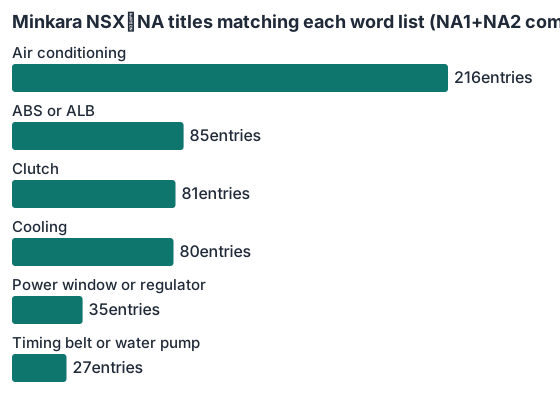
Limits: owners post by choice, the group mixes NA1 and NA2 (87 entries state NA1, 51 state NA2, and the rest state neither), and a title match shows a word in a title, not the cause of a job. Use the counts to decide what to ask, never to rank how likely a part is to fail.
US public data is thin. NHTSA’s recall data for Acura NSX shows 1 recall for the 1991 model year (campaign 95V103001, received May 24, 1995): the front seat belt buckle release button can break. It is not an engine or transmission recall. Model years 1992 to 1997, 1999 and 2001 each show 0 recalls in the same query. Complaints for Acura NSX 1991 to 1997 total 8: 5 for 1991, 2 for 1992 and 1 for 1994 (the 1993, 1995, 1996 and 1997 model years have none). Of those, 3 concern ABS (section 3) and 1 a transmission part (section 4). These US records are separate from the Japanese-market car and from the Minkara counts.
7. Whether the car can enter your country depends on the plate’s build month and the destination rule
Read the build month off the plate, then check it against your destination rule in the table. The 25-year rule is the one most buyers meet first.
As of October 2026. For the build-month method, see 25-year rule manufacture month.
| Destination | Rule | Condition |
|---|---|---|
| United States (federal safety, NHTSA) | The vehicle is 25 or more years old (49 CFR 591.5(i)(1)) | We could not confirm a month-by-month age test from the NHTSA page; we limit this to “built 25 or more years ago” |
| United States (EPA emissions) | At least 21 years old, counted as import year minus calendar year of manufacture, in original form (code E) | A replaced engine must be the same model as originally installed, so confirm the engine on the car |
| Canada (Transport Canada) | Vehicles older than 15 years of age are exempt on import | Age is determined primarily by the month and year of manufacture on the compliance label; without valid proof of age, normal admissibility review applies |
| Canada (provinces) | Some provinces do not license right-hand-drive vehicles | Check with the provincial office before importing |
An editorial calculation for the earliest cars: the NSX went on sale in September 1990, and 25 years from that month is September 2015. This assumes a month-level test, which we could not confirm from a primary source. As of 2026, an early NA1 is already past 25 years either way. Always check the build month on the car’s plate, not the model year.
8. Honda Heritage Works reproduces some discontinued first-generation NSX parts from April 1, 2026, but its restoration service is offered only in Japan and ABS supply is not confirmed
Heritage Parts covers “certain” discontinued parts, so do not assume a part you need is included.
Honda’s announcement says Honda Heritage Works starts on April 1, 2026, and both services start with the first-generation NSX. Heritage Parts reproduces and supplies certain discontinued genuine parts, which means some of them, not all. The Restoration Service is described as a new service offered in Japan. Honda’s announcement does not name an ABS unit, so we treat ABS supply as unconfirmed. Ask the exporter and your own parts supplier before counting on any specific part.
Update triggers for this article: a Honda announcement that widens Heritage Works or names the ABS, a change in the NHTSA, EPA or Transport Canada rules above, and a new count of the Minkara group (we plan to repeat it yearly).
FAQ
Q1. How do I tell an NA1 from an NA2 in a listing?
Ask for the chassis code and the engine code from the registration certificate in writing. The NA1 in this article uses the C30A (2,977 cc). We have no primary-source row on the NA2. In Minkara’s group, 87 entries say NA1 and 51 say NA2 in the title or lead text, and most say neither, so a log entry cannot be assumed to be NA1.
Q2. What if the exporter has no timing belt record?
Treat the belt as unknown and say so in your message. We give no interval or price because we found no primary source. One Minkara owner’s NA1 entry shows a belt replaced together with other items at a shaken service, which is what a specific record looks like.
Q3. Is replacing the early ABS with a later unit acceptable?
We cannot say. We read two owner records that describe a swap (one fitted an S2000 ABS, the other a later-type ABS). Both are owner accounts. Ask for the invoice, shop and date, and check the destination’s inspection rules. Honda’s supply of an ABS unit under Heritage Parts is not confirmed.
Q4. Does 6,264 mean the NSX is unreliable?
No. 6,264 is the number of posts in Minkara’s NSX・NA group (October 13, 2026), NA1 and NA2 combined. It counts what owners chose to post, not how many cars failed, and it has no denominator of cars.
Q5. Does the Type R need different checks?
The same five records apply. Honda’s heritage page says the Type R was released in 1992, and Honda’s archive describes a 3-year limited production and about 120 kg of weight reduction against the base car. Our counts do not separate the Type R, so we have no Type R log numbers.
Q6. When can I import an NSX NA1 into the US or Canada?
As of October 2026: the US needs the car to be 25 or more years old for the federal safety rule, and 21 years or more with the original engine type for the EPA exemption; Canada exempts vehicles older than 15 years, judged mainly by month and year of manufacture. See section 7 and the 25-year rule by manufacture month.