Honda DC5 Type R High Mileage: When Evidence, Not Kilometres, Stops the Bid
この記事の要点
- There is no verified kilometre number at which a Honda DC5 Integra Type R becomes “too high mileage.” The stop line is missing or contradictory evidence.
- A K20A engine code alone does not identify a genuine Type R. Match the car against Honda’s Type R specification before judging its mileage.
- Japanese examples at 200,000 km and above prove that such cars exist; they do not prove original-engine life, reliability, or the condition of the car in front of you.
- Use the same four-part evidence gate at every mileage: identity, mileage continuity, maintenance history, and current-condition findings.
For a Honda DC5 Integra Type R K20A with high mileage, the odometer selects which evidence row to read; it does not decide the bid. A car showing 150,000 km can still be a Stop if its identity and history cannot be reconciled. A car above 300,000 km can remain a Conditional candidate if the missing evidence is clearly defined and can be supplied before bidding.
This guide turns verified Honda specifications, a DC5-generation sample of 149 Japanese maintenance-log titles, Japanese retail observations, and individual high-mileage owner reports into one remote-buying decision. It does not estimate failure rates or promise remaining engine life.
There is no single kilometre limit for a DC5 Type R—missing evidence is the stop line
“Too many kilometres” on a DC5 Type R is not a fixed engine-life number. It is the point at which missing identity, history, or current-condition evidence makes an informed bid impossible.
Mileage matters because it tells you how much history needs explaining. It cannot, on its own, establish that the K20A is original, that the car is a factory Type R, that surrounding systems are sound, or that recorded maintenance belongs to the same vehicle.
Use these four inputs for every candidate:
- Evidence that the individual car matches Honda’s Type R specification.
- History sufficient to judge whether the displayed mileage is continuous.
- Records of maintenance already completed, clearly separated from planned work.
- Current-condition findings for the K20A, cooling system, six-speed transmission and clutch, suspension and steering, and engine mounts.
The decision boundary is therefore evidence-based:
| Avoid this judgment | This is OK |
|---|---|
| “150,000 km is below the danger line, so bid.” | Use 150,000 km only to find the relevant row, then apply all four evidence checks. |
| “A DC5 has reached 320,000 km, so this one will too.” | Treat the 320,000 km-plus owner report as proof of possibility for one car, not a life estimate for another. |
| “The engine sounds healthy, so the whole car is healthy.” | Record the engine observation and assess cooling, drivetrain, mounts, suspension, and steering separately. |
| “The seller says it is a Type R, so the badge and K20A are enough.” | Reconcile the individual car with Honda’s Type R specification before using Type R comparisons. |
This is deliberately stricter about evidence than it is about kilometres. It also works in the opposite direction: low mileage never overrides an identity conflict, an unexplained record gap, or a refusal to provide current-condition findings.
A K20A badge alone does not prove that the car is a genuine DC5 Type R
Honda’s own specifications show why “K20A” is necessary but not sufficient: the engine designation also appeared outside the Type R grade. Verify the complete specification, not one label.
The 2001 Japanese Type R specification identifies an LA-DC5 with a K20A, a six-speed manual transmission, and the following engine figures. Honda’s archived later specification also identifies the ABA-DC5 Type R and retains the same claimed output. These are comparison points, not a substitute for evidence tied to the individual car.
| Honda specification item | Verified Type R reference | How to use it remotely |
|---|---|---|
| Model context | 2001 Japanese-market LA-DC5 Type R | Ask the agent to show evidence connecting the individual car to the claimed grade and specification. |
| Engine designation | K20A | Do not treat the designation alone as proof; Honda also lists K20A for a lower-output 2001 iS and the later Type S. |
| Displacement | 1,998 cm³ | Use only as a consistency check, not a unique Type R identifier. |
| Claimed maximum output | 162 kW (220 PS) at 8,000 rpm | Compare the claimed grade with Honda’s specification; do not infer current output. |
| Claimed maximum torque | 206 N·m at 7,000 rpm | This is a catalogue figure, not a current-condition measurement. |
| Compression ratio | 11.5 | A Type R specification reference, not evidence of the present engine’s internal condition. |
| Valve gear | DOHC, chain drive, two intake and two exhaust valves | Confirms the official configuration; it does not prove the chain system is fault-free. |
| Fuel | Premium unleaded petrol | A specification condition worth reconciling with the car’s operating history where evidence exists. |
| Transmission | Six-speed manual | Confirm the individual car rather than relying on the shift lever or listing text. |
| Weight reference | 1,170 kg without air conditioning; 1,180 kg with it | Applies to the 2001 Type R specification. The later air-conditioned ABA-DC5 reference is 1,190 kg. |
Honda lists 162 kW (220 PS) at 8,000 rpm for the Type R in both the 2001 specification and the model announced in September 2004 and sold through September 2006. That consistency helps define the reference car. It does not tell you whether a used example retains its original engine, factory state, or output.
The safest order is identity first, mileage second. If you are still choosing among build periods, read DC5 which year to buy; do not let an attractive mileage figure shortcut the grade check.
At 150,000, 200,000 and 300,000 km, use the same evidence gate—not a claimed engine limit
Choose the row matching the displayed odometer, then request the same four inputs in every band. The bands organise evidence; they are not failure thresholds or inspection standards.
The retail context below comes from a small observation of 17 DC5 listings on August 21, 2026. The set mixed Type R with Type S/base cars, while its high-mileage Type R subset included examples above 150,000 km. It is not a current market census and cannot establish engine life.
| Displayed mileage | What the verified evidence shows | What the row cannot tell you | Next action |
|---|---|---|---|
| 150,000 km and above, below 200,000 km | The August 21, 2026 retail observation included Type R listings above 150,000 km, including one at 160,000 km. | Remaining life, safety, failure probability, or a mechanical pass line. | Request identity evidence, mileage continuity, completed-maintenance records, and current-condition findings for all major systems. |
| 200,000 km and above, below 300,000 km | Verified examples include an owner who bought a Type R at 200,000 km, a short observation of a rental Type R above 200,000 km, and a 2005 Type R retail listing at 213,000 km. | Whether the candidate is healthy, trouble-free, or more likely to fail than a car in another band. | Apply the same four inputs. Never upgrade the result merely because another car reached this distance. |
| 300,000 km and above | Individual owners reported more than 320,000 km and nearly 330,000 km. | Original-engine survival, unrecorded repairs, remaining life, or a universal safe limit. | Apply the same four inputs and keep the reports as possibility evidence only. |
Candidates below 150,000 km use the same gate. This article gives more detail above that figure because the verified observations and target question concern those higher-mileage bands—not because 150,000 km is a causal threshold.
The price observations illustrate the same limitation. On August 21, 2026, the small retail sample included a 2005 Type R at 213,000 km with a ¥1,824,000 asking price and a 2006 Type R at 160,000 km with a ¥2,675,000 asking price. The editor-defined high-mileage band above 150,000 km was represented mainly by two Type R listings with asking prices from ¥1,820,000 to ¥2,700,000. Those are single retail asking-price observations, not completed sales and not proof that mileage caused the difference.
Real 200,000–330,000 km cars prove survival, not trouble-free life
The Japanese owner reports establish that DC5 Type Rs can be present at these odometer readings. Their conditions do not establish an original, repair-free K20A lifespan.
Each row below keeps the reporting condition beside the mileage. Sources were retrieved on October 5, 2026; later mileage, repair progress, sale status, and mechanical condition were not tracked.
| Reported car | Information condition at retrieval | What it proves | What it does not prove |
|---|---|---|---|
| LA-DC5 Type R bought at 200,000 km | Owner self-report. The same page said the owner was saving for an oil-leak repair and replacement of rubber components. That work was planned, not confirmed complete. | A Type R was purchased at the reported distance, with outstanding work described. | That the work was completed, the engine was original, or the car was trouble-free. |
| 2007-registered DC5 Type R rental car above 200,000 km | One driver’s observation during a six-hour drive described the engine as lively. No measurement was supplied. | The car was operating and received a positive short observation. | Long-term reliability, internal engine condition, or the state of other systems. |
| ABA-DC5 Type R above 320,000 km | Owner reported buying it new, still owning it, and having more than 320,000 km. The profile displayed 647 maintenance-log entries. | Long ownership at very high reported mileage can coexist with extensive maintenance documentation. | That all distance was covered without repair, or that another car can repeat it. |
| DC5 Type R nearly at 330,000 km | Owner self-report associated with ownership since 2001 and circuit use. The profile’s mileage field still showed 245,038 km, indicating an update lag. | A long-term owner reported approaching 330,000 km under a use history that included circuit activity. | The exact current odometer, original-component life, or present mechanical condition. |
The important distinction is survival versus provenance. “This car exists at high mileage” is evidence. “The original K20A reached that mileage without significant intervention” requires a service and component history that these reports do not provide.
That is why a high-mileage example can offer reassurance without clearing a candidate. It removes the simplistic claim that every DC5 must be discarded at one distance. It does not replace inspection evidence for the one you may buy.
Separate K20A condition from the cooling, mounts, clutch and chassis around it
A running or healthy-sounding K20A answers only one part of the purchase question. The surrounding systems need their own evidence.
The six-hour observation of a 200,000 km-plus rental Type R is a useful warning. The driver described the engine as lively, but that was an observation without measurements. It cannot clear the cooling system, clutch, transmission, mounts, suspension, steering, or chassis.
| Evidence area | What to ask the agent to return | Why it remains separate |
|---|---|---|
| K20A itself | Current-condition findings and the maintenance history connected to this engine | An engine observation does not establish originality, remaining life, or the state of the rest of the car. |
| Cooling | Current-condition findings plus records of completed cooling work | The 149-title sample contains cooling-system posts, so this remains a distinct question. |
| Six-speed transmission, clutch and limited-slip differential (LSD) | Findings for all three systems, confirmation of the represented LSD, and records of completed work | The Honda specification confirms the six-speed configuration, while the owner-log sample includes a clutch post; neither tells you this car’s condition or confirms the represented LSD. |
| Suspension and steering | Findings for the front suspension and steering, plus relevant maintenance records | This was the largest named wear cluster among the selected title categories, but the count is not an incidence rate. |
| Engine mounts | Current-condition findings and any completed replacement record | A running engine can still sit in aged surrounding hardware. |
| Chassis and use history | Evidence of the car’s condition and disclosed use or modification history | The near-330,000 km report includes circuit-use context, showing why mileage must be read beside use. |
For comparison with another K20A-equipped Type R, see Honda Civic Type R EP3 common problems. Use it as a neighbouring inspection reference, not as proof that an EP3 observation applies to a DC5.
Avoid this judgment: “The K20A is the expensive part, so a good engine clears the purchase.”
This is OK: “The engine evidence is one completed input. I still need separate answers for cooling, drivetrain, mounts, suspension, steering, and the car’s use history.”
The 149-post sample prioritises questions, but it does not rank failure risk
The log counts identify systems worth asking about. They cannot be converted into DC5 Type R failure rates, risk rankings, or expected repair intervals.
The sample was collected on July 31, 2026 from 149 DC5-generation Minkara maintenance-log titles across five categories. Type R and Type S are mixed, titles rather than full repair narratives were classified, and repeat posts from the same owner may be present.
| Classified topic within the 149 titles | Posts | Valid use in this guide | Invalid use |
|---|---|---|---|
| Front suspension and steering wear | 7 | Put suspension and steering on the agent’s evidence request. | Claim that it is the most likely Type R failure. |
| Cooling system | 3 | Ask separately about cooling condition and completed work. | Estimate a cooling-system failure rate. |
| Ignition | 3 | Keep ignition within the current-condition response. | Infer a Type R-specific frequency. |
| Engine mounts | 1 | Do not let an engine-only answer clear the mounts. | Treat one title as a prevalence estimate. |
| Clutch | 1 | Request clutch findings separately from engine condition. | Rank clutch risk below cooling risk. |
| Timing-chain tensioner failure | 0 | Preserve uncertainty: no matching title appeared in this selected sample. | Claim that the failure does not occur. |
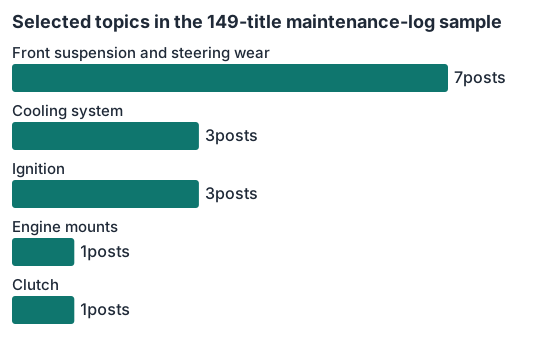
The underlying sample also contained roughly 15 oil-change titles among 45 engine-bay entries. Repeated routine logs and possible repeat owners mean even apparently reassuring maintenance activity cannot be read as a representative service rate.
For the full classification, read Honda Integra Type R DC5 common problems. For why title counts are useful for finding clusters but unsuitable for incidence estimates, read how we aggregate Japanese owner maintenance logs.
The correct translation is: “these systems deserve named questions.” The incorrect translation is: “seven suspension posts make suspension more dangerous than cooling.” The denominators, independence, grade separation, vehicle mileage, and exposure needed for that comparison are not available.
Modification and use history can outweigh a lower odometer reading
A lower odometer does not compensate for unclear modification or use history, while a higher odometer does not automatically defeat a well-explained car.
The verified high-mileage reports show why context changes interpretation. One near-330,000 km owner profile includes circuit-use context. Another car above 320,000 km displayed 647 maintenance-log entries. A 200,000 km buyer described planned oil-leak and rubber-component work rather than completed repairs. These are different histories even when each qualifies as “high mileage.”
| Avoid this judgment | This is OK |
|---|---|
| “Lower mileage means gentler use.” | Ask for disclosed use and modification history independently of the odometer. |
| “Circuit use makes the car an automatic Stop.” | Treat it as context requiring a coherent identity, maintenance, and current-condition account. Stop if material gaps cannot be resolved before bidding. |
| “A long maintenance-log profile proves the car is healthy now.” | Use extensive records to trace work, then request current-condition findings. |
| “Planned repairs count as maintenance completed.” | Keep plans and completed work separate. The 200,000 km owner report described saving for work, not its completion. |
| “A high-mileage car with records is automatically better than a low-mileage car.” | Apply the same four inputs to both and classify the response, not the number. |
Modifications also make identity evidence more important. A visible engine designation or six-speed transmission can match part of the Type R specification without proving the whole car’s original grade. Do not ask appearance to do the job of provenance.
The practical exception runs both ways. A high-mileage car may remain in consideration when all four inputs are coherent. A lower-mileage car may reach Stop when identity conflicts, history cannot support mileage continuity, or the seller refuses to supply evidence that could resolve the uncertainty.
Ask the Japanese-side agent for identity, mileage continuity, maintenance history and current-condition evidence before bidding
Send one structured request covering all four inputs. Do not let a positive answer about one system substitute for the unanswered parts.
The wording below intentionally avoids naming a particular Japanese document, field, inspection procedure, pass value, or interval. The verified research supports a generic evidence request, not a claim that one document or measurement alone proves the car.
You can send this to the agent:
Before I decide whether to bid, please return evidence for four areas. First, provide the available material that lets me compare this individual car with Honda’s DC5 Type R specification, rather than relying only on its badge or K20A label. Second, provide the available history that lets me judge continuity of the displayed mileage. Third, separate records of maintenance already completed from work that is only recommended or planned. Fourth, return the current-condition findings available for the K20A, cooling system, six-speed transmission and clutch, suspension and steering, engine mounts, and any disclosed modification or demanding-use history. Please also confirm whether the represented limited-slip differential (LSD) is present and return any current-condition finding available for it. Please identify any item that cannot be confirmed before the bid.
Process the response in order:
- Identity: Can the supplied evidence be reconciled with Honda’s Type R reference specification?
- Mileage continuity: Is there enough history to judge whether the displayed number forms a coherent record?
- Completed maintenance: Which work is documented as done, and which items are merely proposed?
- Current condition: Has the agent returned findings for each named system rather than one overall assurance?
- Open items: Can every important gap be resolved before bidding, and has the seller agreed to provide what is missing?
Do not silently convert “not available” into “probably fine for an old car.” Record it as an open input and carry it into the final classification.
Bid only when the evidence gate is complete; kilometres alone never clear or stop the car
Classify the evidence response as Bid, Conditional, or Stop. “Bid” here is an editorial signal to continue to price and import-eligibility checks—not a guarantee of mechanical health or remaining life.
| Decision | Exact evidence condition | Next action | What the decision does not promise |
|---|---|---|---|
| Bid | All four inputs have been returned, and there is no unresolved contradiction among Type R identity, displayed mileage, maintenance history, and current-condition findings. | Continue to price and import-eligibility decisions. | Mechanical health, freedom from future faults, remaining component life, or a final instruction to buy. |
| Conditional | Part of an input is missing or ambiguous, but the gap is specific and additional evidence or confirmation can be made an explicit pre-bid condition. | Re-send the relevant part of the evidence request. Do not move to an unconditional Bid until it is resolved. | That missing evidence is normal or acceptable merely because the car has high mileage. |
| Stop | Type R identity conflicts with the evidence, evidence is refused, or a material gap in identity, mileage continuity, maintenance, or current condition cannot be resolved before bidding. | Do not bid; compare another car. | A mechanical rejection based only on the odometer number. |
This classification is an editorial synthesis of the verified evidence, not a Honda test standard or an official inspection threshold. It deliberately avoids inventing a kilometre cut-off that the sources do not provide.
Once a car reaches Bid, compare its money case with japanese auction prices research. If the destination is the United States, check the actual production timing with 25-year rule manufacture month rather than treating model year alone as the answer.
Limits and update dates
- The 149-title DC5 maintenance sample was collected July 31, 2026. It mixes Type R and Type S and classifies titles, not verified repair incidence.
- The 17-listing retail observation was made August 21, 2026. It mixed Type R with Type S/base cars and recorded asking prices, not completed sales.
- The individual owner sources were retrieved October 5, 2026. Their mileage fields, profiles, maintenance logs, and repair plans can have different update times.
- No later mileage, maintenance completion, mechanical change, or sale status was tracked after those dates.
- The relevant figures and dates should be updated together if the maintenance sample or retail observation is rebuilt, or if the owner examples are retrieved again and display changed values.
FAQ
Q1. How many kilometres is too many for a DC5 Type R?
There is no verified universal limit in the available evidence. Use mileage to select the relevant band, then stop only when identity, mileage continuity, completed maintenance, or current-condition evidence is contradictory, refused, or cannot be obtained before bidding.
Q2. Can a K20A last beyond 200,000 km?
Individual DC5 Type R examples were reported above 200,000 km, including more than 320,000 km. They prove that such cars exist, not that an original K20A is guaranteed to reach those distances without major work.
Q3. Does a K20A engine code prove it is a Type R?
No. Honda’s specifications show K20A use outside the Type R grade, including the 2001 iS and later Type S. Match the individual car against the complete Type R specification and supporting identity evidence.
Q4. Is a 300,000 km DC5 Type R automatically a bad buy?
No, but it is not automatically acceptable either. Apply the same four-input gate and treat high-mileage owner reports only as proof of possibility. A material unresolved gap still makes the decision Stop.
Q5. What should a Japanese agent check before I bid?
Ask for evidence of Type R identity, history sufficient to judge mileage continuity, records of completed maintenance, and current-condition findings for the K20A, cooling, six-speed transmission and clutch, suspension and steering, engine mounts, modifications, and demanding use.
Q6. Do 149 owner posts show DC5 failure rates?
No. The July 31, 2026 sample mixes Type R and Type S, classifies maintenance-log titles, and may include repeated posts from the same owner. It identifies question areas but cannot estimate failure rates or rank risk.