EK9 Civic Type R B16B Pre-Import Fault Guide — 40,541 Japanese owner records, E-EK9 vs GF-EK9 chassis breakdown
この記事の要点
- This guide is built from 40,541 Japanese owner maintenance records on Minkara for the Honda Civic Type R EK9. It covers the EK9 produced August 1997 to 2000 with the B16B engine only — not the EP3 (K20A) successor.
- The EK9 comes in two chassis codes: E-EK9 (early, August 1997 – August 1998, 103 dB exhaust limit) and GF-EK9 (late, September 1998 – 2000, 96 dB exhaust limit). The difference matters for aftermarket exhaust budgeting in stricter markets.
- The B16B has two engine-specific failure modes that no English-language buyers guide covers: spool valve packing leak (first documented exchange at 176,214 km) and EACV idle failure (documented as a known EK9 trait, onset around 130,000 km).
- Floor rust can reach structural holes — an owner record describes being able to see the road through the floor pan. This is caused by the front wheel throwing water directly into the sill channel, and it is unavoidable by design.
- The timing belt must be replaced by years elapsed, not mileage: the reference interval is 105,000 miles or every 84 months (7 years). One Japanese owner exchanged a belt at 200,533 km with no known prior history.
The English-language EK9 guides all warn about rust, auction grades, and “check the VTEC.” That advice is correct. What they do not cover is the specific B16B failure modes that appear only in Japanese owner logs, the exhaust regulation difference between the two chassis codes, or the floor corrosion mechanism. This article is built from primary Minkara owner maintenance records and Honda official press materials, and is limited to facts those sources confirm.
This guide is built from 40,541 Japanese owner maintenance records — here is what the data shows
The Honda Civic Type R EK9 (August 1997 – 2000) is Honda’s first purpose-built Type R hatchback, equipped exclusively with the 185 PS / 8,200 rpm B16B DOHC VTEC engine and a factory helical LSD — one of approximately 16,000 units produced.
As of September 29, 2026, the Minkara Japanese owner maintenance log index for the Civic Type R EK9 (model group 3.3135) contains 40,541 maintenance records. That is the data foundation for this article. The figure is a point-in-time count and will grow over time; the value confirmed at the date of research is used throughout.
This article covers the B16B-engined EK9 produced August 1997 to 2000. It does not cover the EP3 Civic Type R (K20A, 2001 onward) or the EK4 SiR (B16A). For EP3-specific problems, see Honda Civic Type R EP3 common problems before importing.
Knowing which items to inspect — and which to negotiate — before transferring money is the purpose of this guide.
The EK9 comes in two chassis codes — E-EK9 and GF-EK9 — and they are not the same car for exhaust regulations
If you are looking at an EK9, the first thing to confirm is which chassis code you are buying. The two codes are not interchangeable for aftermarket exhaust purposes.
The chassis code difference is not about power output — both E-EK9 and GF-EK9 use the identical B16B producing 185 PS at 8,200 rpm. The difference is the noise regulation applied at the time of manufacture. Japan tightened exhaust noise standards between the two production runs, and the stricter limit follows the car throughout its life.
| Chassis code | Production period | Close-proximity exhaust limit | Notes |
|---|---|---|---|
| E-EK9 (early) | August 1997 – August 1998 | 103 dB | Original specification; more permissive for aftermarket exhausts |
| GF-EK9 (late) | September 1998 – 2000 | 96 dB | Stricter regulation; many bolt-on exhausts exceed this limit at Japanese shaken |
The 103 dB limit on E-EK9 gives considerably more headroom for aftermarket exhaust fitment without failing Japanese shaken noise testing. The GF-EK9’s 96 dB limit is close enough to the output of many popular sports exhausts that fitting one without a noise test can result in a failed re-registration or shaken failure in markets that enforce Japanese noise standards.
Why this matters for import buyers: If you plan to keep the car on Japanese shaken paperwork, or if your domestic market enforces the original Japanese noise certificate, the GF-EK9 is more restrictive. If you are in a market that applies its own noise standard independently (such as the US, which tests to FMVSS standards, not Japanese standards), this distinction may be less operationally significant — but it affects the resale value and JDM compliance documentation.
Avoid this judgment / This is OK:
| Avoid this judgment | This is OK |
|---|---|
| “Both EK9s are the same — same engine, same power.” | “The B16B spec is identical, but E-EK9 allows 103 dB exhausts and GF-EK9 only allows 96 dB.” |
| “The GF-EK9 is newer so it must be the better buy.” | “GF-EK9 is later production and has minor interior updates, but it carries a stricter exhaust noise limit.” |
| “I can always fit any sports exhaust — it passed shaken in Japan.” | “If the car was imported with a non-standard exhaust, check the noise test result. The GF-EK9 limit is tight.” |
To verify which chassis code a specific car has: the type plate (型式プレート) inside the driver’s door jamb or the shakken certificate (車検証) lists the full chassis code. The model number column reads either “E-EK9” or “GF-EK9.”
Rust is the number one reason EK9 imports fail inspection — floor panels can corrode to structural holes
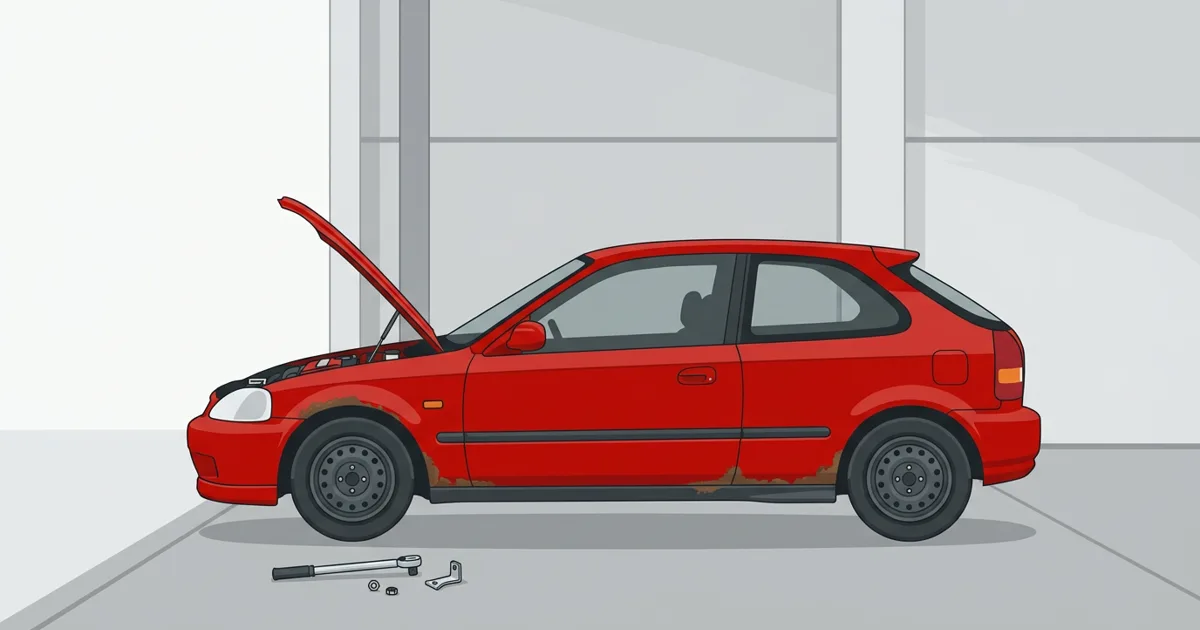
Floor corrosion on the EK9 is not cosmetic. Japanese owner maintenance records describe holes through the floor pan severe enough to see the road surface beneath the car.
One Japanese owner (hinata.jp EK9 rust repair records, retrieved 2026-09-29) documented floor panel corrosion that had progressed to a hole through which the ground was visible. The description is: “穴から地面が見える” — “you can see the ground through the hole.” This is a structural condition, not surface rust.
Why the EK9 floor corrodes from the inside out: The front wheel arch design channels water thrown by the front tyres directly into the longitudinal sill channel. Japanese owner records describe it as: the water thrown up by the front wheel strikes this channel directly (“前輪が巻き上げた水分はこの溝に直撃する”). Water pools in the channel, is sealed in by underbody undercoating applied on top rather than underneath, and corrodes the floor panel from below. The corrosion is often invisible from above until it has progressed through the panel.
In addition to structural floor rust, Japanese owner records for the EK9 exterior category identify rain leaks and floor rust as a well-known recurring problem for this model (“シビックでは雨漏り+フロア錆は定番のようです” — “rain leak plus floor rust is a known recurring issue on the Civic”). External paint issues — including roof repainting — have been documented at costs of around ¥69,000 for the roof alone (exterior maintenance records, Minkara bi=4 mg=3.3135, 2026-09-29).
Pre-import rust check list for the EK9:
- Remove the floor mats and press the carpet in the driver and passenger footwells. Soft spots, moisture, or any flex underfoot indicate floor pan compromise.
- Inspect the outer sill channel (the longitudinal member running along the bottom edge of each door opening) with a torch. Look for scale rust, flaking, or holes.
- Check the inner wheel arch behind each front tyre. The water ingress point is a groove at the top of the arch where the arch liner meets the body — press against it and look for rust blistering.
- From underneath: inspect the floor pan from the firewall to the rear axle. Any area where undercoat has bubbled or cracked is a candidate for penetrating rust.
- Rain leaks entering the cabin accelerate floor corrosion. Check all window seals and the windscreen surround for lifted or cracked rubber.
A car with structural floor holes or sill rot should be treated as a project car requiring full body restoration, not a usable daily vehicle. Factor the cost of a professional rust repair (floor pan replacement, sill welding) into any negotiation.
The B16B has two engine-specific failure modes that no English guide covers — spool valve packing and EACV
These are the two faults that differentiate Japanese EK9 owner knowledge from English-language buyers guides. Both are documented in primary Minkara owner records and both are specific to the B16B’s VTEC oil circuit architecture.
| Fault | Common onset (km) | Symptoms | Repair difficulty | Parts / cost (reference, as of 2026-09-29) |
|---|---|---|---|---|
| Spool valve packing leak | ~176,214 km (first documented exchange) | Oil seeping from spool valve body; VTEC engagement hesitation; minor oil loss | Moderate — engine-out not required; requires correct torque on reassembly | Filter ASSY spool valve (part 15825-P08-005): approx. ¥1,507 / Solenoid filter ASSY (part 36172-P08-015): approx. ¥539 |
| EACV idle failure | ~130,000 km (documented onset) | Rough idle at operating temperature; unstable revs at warm idle; idle hunt | Low–Moderate — EACV cleaning is sufficient in early cases | Cleaning solvent; replacement EACV if cleaning fails |
Spool valve packing leak in detail: The B16B uses a VTEC spool valve to direct oil pressure to the high-lift cam lobes. The rubber packing that seals the spool valve housing degrades over time and begins to seep engine oil. A Japanese owner (hinata.jp EK9 maintenance records, 2026-09-29) documented the first replacement at 176,214 km on their car. The spool valve itself is accessible without removing the engine. When reassembling, the mounting bolt must be torqued to 12 N·m (1.2 kgf·m) — undertightening causes immediate re-leak, overtightening can crack the housing.
B16B spool valve packing reference part numbers (as of 2026-09-29, hinata.jp source):
- Filter ASSY, spool valve: 15825-P08-005 — approx. ¥1,507
- Filter ASSY, solenoid: 36172-P08-015 — approx. ¥539
- Mounting bolt torque: 12 N·m
These are historical prices from a Japanese maintenance record and may not reflect current dealer pricing. Verify with a Honda dealer at the time of order. These part numbers are cited as reference for pre-purchase inspection negotiation purposes.
EACV idle failure in detail: The Exhaust Air Control Valve (EACV) controls idle air bypass. Japanese owner records specifically describe EACV failure as a known recurring trait of the EK9 (“EK9は持病的にこのトラブルが発生” — “this trouble occurs as a known trait of the EK9”). One documented case recorded onset at around 130,000 km. Symptoms are rough warm idle and idle instability. A thorough clean of the EACV passages resolves the problem in early-stage cases; a replacement unit is required if the valve body is worn through.
When viewing an EK9 pre-purchase, request a cold start and let the engine warm fully to operating temperature. Idle quality at warm running temperature is the diagnostic test for EACV function.
The timing belt must be replaced on years elapsed, not mileage — the 10-year benchmark is the safe threshold
The B16B uses a DOHC belt-driven camshaft system. The timing belt degrades on time, not only distance — a car stored for years with low mileage can have a belt that is close to end of life even at modest odometer readings.
One Japanese owner (Minkara user TNM48, 2026-09-29) replaced the timing belt on their EK9 at 200,533 km with no confirmed prior replacement history. This is not a recommendation to run belts this long — it is a worst-case scenario documentation. Another Japanese owner (Minkara user banban1978zzz) replaced at exactly 10 years from the previous belt change. The 10-year benchmark is the practical upper limit, not an interval to aim for.
The reference replacement interval for Honda 1.6L DOHC VTEC models from 1997 onward is 105,000 miles or every 84 months (7 years), per timingbeltintervals.com — a third-party reference site; Honda’s official service manual interval has not been independently confirmed from a primary source in this research. The 105,000-mile distance converts to approximately 169,000 km (編集部算出: 105,000 × 1.60934 ≈ 169,000). On a 25-year-old car, the time-based limit is almost always the binding constraint.
Critical reassembly note from Japanese owner records: When the TNM48 owner replaced the belt at 200,533 km, they found the timing belt guide was warped (反っている). The correct installation orientation is to face the curved (belly) side of the guide toward the belt — installing it reversed risks the belt riding off the guide. This is a detail that catches technicians unfamiliar with this specific engine.
The crankshaft pulley bolt on the B16B is torqued to 181 N·m. The TNM48 Minkara record notes that an impact wrench was insufficient to break this loose and the job required a special service tool plus a 1-metre extension pipe. Budget accordingly if you are asking a local workshop to perform this job — it is not a standard oil-change-level timing belt.
Pre-purchase timing belt questions to ask the seller:
- Do you have a receipt or record showing when the timing belt was last replaced (year and mileage)?
- If no record exists, when was the car last serviced?
- Has the water pump been replaced at the same time? (Water pumps are replaced as a kit with the belt on these engines.)
If no belt history can be produced on a car from 1997–2000, budget for an immediate replacement after purchase regardless of mileage.
Verify the chassis plate and engine stamp before paying — EK9 impostors are built on EK4 SiR bodies with a B16A
The EK9 Type R shared its body with the EK4 Civic SiR. This makes visual exterior identification unreliable. An EK4 with a body kit and red badges looks like an EK9. The mechanical difference is significant.
| Spec | EK9 Type R | EK4 SiR (base model) |
|---|---|---|
| Engine | B16B | B16A |
| Maximum output | 185 PS / 8,200 rpm | 170 PS / 7,800 rpm |
| Output difference | — | 15 PS less (編集部算出: 185 − 170) |
| Chassis code | E-EK9 or GF-EK9 | EK4 |
| Helical LSD | Standard (all EK9) | Not standard |
| VTEC engagement | 6,100 rpm | Different mapping |
Source: Honda official press information, engine comparison table B16A vs B16B (cv97-006.html, retrieved 2026-09-29).
How to verify a genuine EK9 at the car:
- Ask for the shakken certificate (車検証). The 型式 (model code) column must read E-EK9 or GF-EK9. EK4 reads EK4.
- Locate the VIN plate on the firewall. The chassis number prefix identifies the model.
- Find the engine identification stamp on the block. The B16B stamp reads B16B- followed by the serial number. A B16A stamp reads B16A.
- Count the output: the B16B produces 185 PS. A car with a B16A swap produces 170 PS — 15 PS less. A compression test and dyno comparison are definitive, but the shakken certificate is the fastest check.
- Confirm the factory helical LSD is present (see H2-7 below).
A genuine B16B engine in a genuine EK9 body with matching shakken documentation is not common in the used market. If any of the three elements (shakken, VIN, engine stamp) are inconsistent, the asking price should reflect it.
The helical LSD, Recaros, and 5-speed short-ratio gearbox are standard — verify they are still present
The EK9 was produced with a specific factory specification that makes it worth importing. All three major performance components are standard on every EK9 — they were not optional extras. Verifying they are present and original is a pre-purchase step.
Factory specification summary (Honda official press materials, cv97-013.html, 2026-09-29):
- Helical LSD: A mechanical torque-sensing helical limited-slip differential (トルク感応型ヘリカルLSD) is standard on all EK9 graded variants. This is confirmed in Japanese used car catalogues (HMR EK9 guide, 2026-09-29). The S1 Honda press sheet and Wikipedia Civic Type R article both reference LSD as standard equipment.
- 5-speed close-ratio gearbox: Final drive ratio 4.400; first gear 3.230; fifth gear 0.848. Second gear uses a dual-cone synchroniser. This gearbox is purpose-built for the Type R programme and not shared with the EK4.
- Recaro bucket seats: Factory-fitted Recaro seats are referenced in contemporary descriptions of the EK9. These are frequently the first item replaced on modified examples — confirm the seats are present, check condition of bolsters, and verify the seat rail mounting bolts show no signs of previous removal and reinstallation on non-standard rails.
What to check:
| Item | How to verify | Red flag |
|---|---|---|
| Helical LSD | Lift one front wheel: with the other front wheel on the ground, put in gear and try to rotate the raised wheel by hand. A working LSD provides resistance. | Free spin with no resistance suggests a removed or failed LSD |
| 5MT gearbox | Confirm five gears select cleanly. Second gear is the most worn — feel for notchiness on the 1–2 upshift. | Grinding on 2nd or 3rd suggests synchro wear |
| Recaro seats | Check the seat backs for original Recaro embossing or label under the seat. | Generic aftermarket buckets with no label; non-standard floor rails |
An EK9 missing its factory LSD, with replacement non-Recaro seats and a worn second gear synchro is a different car from the factory specification. Price and inspect accordingly.
What to ask before transferring money: a five-point pre-import checklist
This chapter brings the individual fault categories into a single pre-purchase checklist. The EK9 is old enough that every car will have at least one open item — the goal is to know what it is before paying.
EK9 five-point pre-import checklist:
- Chassis code confirmed (E-EK9 or GF-EK9)? Check shakken certificate. Determines exhaust noise limit (103 dB vs 96 dB) and affects aftermarket budgeting.
- Floor rust status? Remove mats, press carpet. Inspect sill channel with torch. Any soft spots or visible holes = structural work required.
- Timing belt history documented? If no receipt or year/mileage record, budget for immediate belt replacement. On a 1997–2000 car, the 84-month time limit is almost certainly already elapsed.
- Spool valve packing: any oil seepage at the valve body? Ask for a warm engine inspection. Look for oil staining on the spool valve housing on the side of the B16B head.
- Factory spec intact (LSD, Recaro, 5MT)? Confirm all three are present before agreeing a price.
Import eligibility: EK9 production ran August 1997 to 2000. Under the US 25-year import rule, each unit becomes eligible 25 years after its manufacture date. Buyers in Australia, New Zealand, and Canada operate under their own eligibility rules, which have different thresholds — verify the current rule for your jurisdiction before purchasing.
For comparable pre-import fault guides on cars from the same era, see Honda S2000 AP1 common problems before importing Japan and Nissan Fairlady Z Z33 common problems before importing Japan.
Once you have confirmed the EK9 passes your checklist, the next step is understanding the full landed cost. Japanese exporters vary significantly in their fee structures — see Japanese car exporter hidden fees for a breakdown of what to ask before transferring funds. (Disclosure: this site may receive a referral fee from services linked on this page.)
FAQ
Q1. What is the difference between E-EK9 and GF-EK9?
E-EK9 is the early production chassis code (August 1997 – August 1998) and GF-EK9 is the late production chassis code (September 1998 – 2000). The engine — B16B, 185 PS / 8,200 rpm — is identical on both. The primary practical difference is the exhaust noise regulation: E-EK9 carries a 103 dB close-proximity limit, GF-EK9 carries a 96 dB limit. This affects what aftermarket exhausts can be fitted while remaining compliant with Japanese noise standards. To identify which chassis you are looking at, check the shakken certificate (vehicle inspection document) — the 型式 column will read either E-EK9 or GF-EK9.
Q2. How do I verify a B16B is not a B16A swap?
The fastest check is the shakken certificate. The 型式 (model code) must read E-EK9 or GF-EK9, not EK4. Second, locate the engine identification stamp on the block — the B16B stamp reads B16B- followed by the serial number; a B16A reads B16A. The output difference is 185 PS (B16B) versus 170 PS (B16A) — 15 PS less, per Honda’s official comparison table. A car with a B16A swap will also lack the helical LSD that is standard on the genuine EK9, since the EK4 SiR base model does not include one.
Q3. How often should the B16B timing belt be replaced?
The reference interval for Honda 1.6L DOHC VTEC engines from 1997 is 105,000 miles or every 84 months (7 years), per timingbeltintervals.com (third-party reference). In kilometres, 105,000 miles converts to approximately 169,000 km (編集部算出). On any EK9 produced 1997–2000, the 84-month time interval is very likely already exceeded. The practical rule: if no replacement receipt with a date can be produced, budget for immediate belt replacement regardless of mileage. A Japanese owner documented a replacement at 200,533 km on a car with no known prior belt history — the belt held, but this is not a target to replicate.
Q4. What does the spool valve packing failure look like on the B16B?
The spool valve is mounted on the side of the B16B cylinder head and is visible from above with the bonnet open. Packing failure produces oil seepage from the joint between the spool valve body and the head. In early stages this appears as a light oil staining around the valve housing. In advanced cases it can produce visible drips or a wet patch on the exhaust manifold shield below. VTEC engagement hesitation — where the cam switchover at around 6,100 rpm feels hesitant or incomplete — can also accompany a failing spool valve, because the oil pressure used to engage the high-lift lobes is not being maintained. The packing replacement itself is inexpensive (parts approximately ¥2,046 for both filters at 2026-09-29 reference prices,編集部算出: ¥1,507 + ¥539); labour is moderate.
Q5. Is floor rust on an EK9 structural or cosmetic?
It depends on how far the corrosion has progressed. In early stages it is surface rust on the floor pan — cosmetic but worth monitoring. In advanced cases documented in Japanese owner records, it becomes structural: holes through the floor panel visible from inside the cabin. The EK9’s front wheel arch channels water directly into the sill channel by design, making corrosion a structural risk rather than a cosmetic one if the car has spent time in wet or salty environments without rust protection. Always physically inspect the floor pan with mats removed, and check the outer sill channel with a torch before purchase.
Q6. What auction grade should I target for a clean EK9?
Japanese auction grade 4 or above is the standard target for import-quality cars. Grade 4 indicates no major exterior damage, and auction interior grades of B or higher are preferred (no major rips or staining). However, auction grade does not assess rust or mechanical condition in detail — a Grade 4 car can still have floor rust or a timing belt past its service life. Grade alone is not sufficient for an EK9 purchase decision. A pre-purchase inspection report (third-party inspector present at the auction yard or dealer lot) is strongly recommended for cars at this price level.
Q7. Is the EK9 eligible under the 25-year US import rule?
Yes, for all production dates. EK9 production ran August 1997 to 2000, so all examples are now within the 25-year window or past it depending on manufacture date. Under the US 25-year import rule, a vehicle becomes eligible 25 years after its specific manufacture date. Buyers should verify the manufacture date on the vehicle’s documentation — the shaken certificate or the VIN plate — and calculate eligibility from that date, not the model year. Regulations are subject to change; confirm the current rule with a licensed US importer or customs broker at the time of purchase.